
How Should You Compare Cash Offers on a Central PA House?

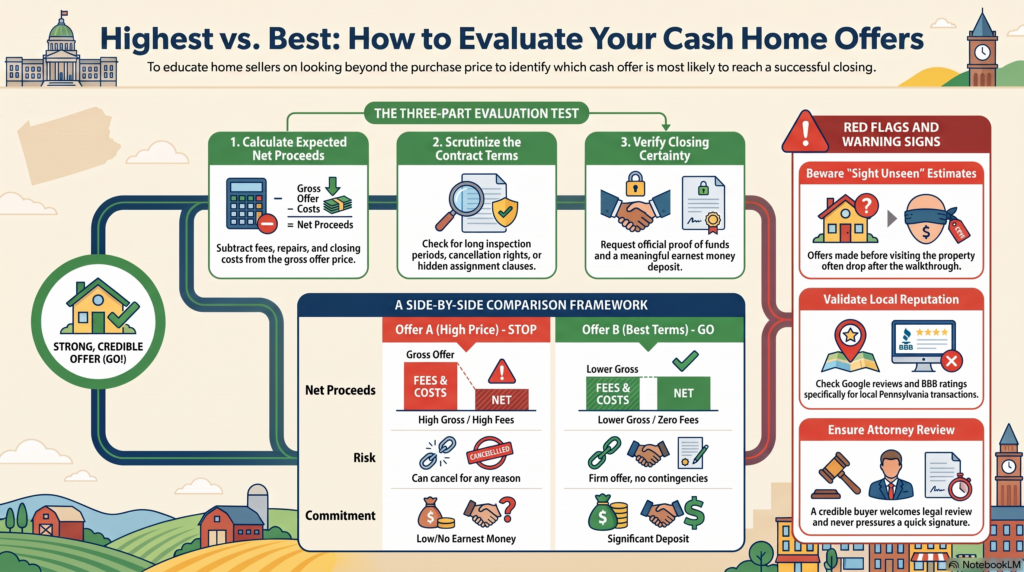
The best cash offer is not necessarily the one with the highest number. A homeowner should compare how much money they will actually receive, what the contract allows the buyer to change, whether the buyer can prove they have the funds, how much earnest money they will deposit, when they can close, and how likely they are to follow through.
A simple rule: do not reject the highest offer just because it is highest, and do not accept it until you verify the price, terms, certainty, and buyer behind it.
This guide is especially helpful for homeowners in Lancaster, Harrisburg, York, Lebanon, Reading, and nearby Central Pennsylvania communities who have received two or more direct cash offers and are unsure how to compare them.
A cash sale may not be the best option when a house is in strong retail condition, the seller has time to prepare it for the market, and maximizing exposure and potential sale price matters more than speed or convenience. In that situation, comparing a direct sale with a traditional listing may be the better first step.
Compare the Entire Offer, Not Just the Purchase Price
Suppose one buyer offers $240,000 and another offers $232,000. The first offer appears to be $8,000 better, but that conclusion may change after you review the agreements.
The $240,000 offer might include a long inspection period, broad cancellation rights, financing or partner approval, uncertain closing costs, or language allowing the buyer to renegotiate after visiting the property. The $232,000 offer might include verified funds, meaningful earnest money, fewer contingencies, seller-friendly closing terms, and a dependable date.
The higher offer could still be the better choice. The point is that its value has to survive a closer review.
A high offer with a weak path to closing may be worth less than a slightly lower offer with clear funds, firm terms, and a credible closing plan.
A Real Example: Why “Craig” Chose the Seventh Offer
Austin Glanzer, co-owner of 717 Home Buyers, recently described a transaction involving an older homeowner in Montgomery County. We will call the homeowner Craig for privacy.
Craig owned an older house that needed substantial repairs. The expenses continued to pile up, and the property had become more of a financial and practical burden than he wanted to carry.
Before speaking with 717 Home Buyers, Craig had already received six offers. The offer from 717 was his seventh, and some of the earlier offers were approximately $8,000 to $9,000 higher.
Craig did not choose the seventh offer simply because of the price. He considered whether the buyer would allow his attorney to review the agreement, provide proof of funds, deposit earnest money, work with a contract supplied by his side, answer his questions, and offer a faster and clearer route to closing.
717 reviewed Craig’s proposed agreement with its own attorneys rather than insisting that he use only the company’s standard contract. Craig ultimately valued that flexibility and closing certainty more than the additional money shown on the other offer sheets.
This does not mean every seller should accept less money. It means every seller should determine whether a higher offer is firm, funded, understandable, and likely to close.
The Four-Part Cash Offer Test
A useful comparison can be organized into four categories: price, terms, certainty, and trust.
1. Price: How Much Will You Actually Receive?
Start with the purchase price, but do not stop there. Ask for an explanation of every amount that could be deducted before closing.
- Are there commissions, service charges, administrative fees, or transaction fees?
- Who pays the title, settlement, recording, and transfer-related expenses?
- Is the buyer asking for repair credits, cleanup credits, or other deductions?
- Will unpaid taxes, liens, mortgages, or other property obligations be paid from the seller’s proceeds?
- What is the estimated amount the seller will receive at settlement?
Ask for a written estimate when possible. Comparing headline prices without comparing deductions can create a misleading picture.
2. Terms: What Does the Contract Allow?
The agreement determines what each party is actually promising. Read it carefully and consider having a Pennsylvania real estate attorney review it when the language is unclear or the transaction is significant to your financial situation.
- How long does the buyer have to inspect the property?
- Can the buyer cancel for any reason during that period?
- Can the buyer lower the price after an inspection or walkthrough?
- Does the purchase depend on financing, an appraisal, a partner, or another buyer?
- May the buyer assign the contract to someone else?
- What happens if the seller needs more or less time before moving?
- What property, belongings, or debris must be removed before closing?
The purchase price is only one contract term. Cancellation rights, inspection language, fees, contingencies, and closing obligations can change the practical value of the offer.
3. Certainty: Can the Buyer Actually Close?
A cash buyer should be willing to explain where the purchase funds are coming from and how the closing will be completed. Proof of funds does not guarantee a closing, but it helps confirm that the buyer has access to enough money to complete the purchase.
Earnest money is another factor. It is a deposit connected to the purchase agreement and demonstrates that the buyer has committed something tangible to the transaction. Sellers should ask how much will be deposited, who will hold it, when it is due, and under what conditions it can be returned.
- Request current proof of funds that reasonably matches the purchase obligation.
- Ask whether the buyer is purchasing with its own funds or depending on another party.
- Confirm the earnest-money amount and deposit deadline.
- Identify the title or settlement company that will handle the closing.
- Ask whether the closing date is a firm commitment or an estimated target.
- Find out what happens if the buyer does not close on time.
A fast closing promise deserves the same scrutiny as a high price. The buyer should be able to describe the steps between signing and settlement, including title work, document preparation, funding, and disbursement.
4. Trust: How Does the Buyer Respond to Reasonable Questions?
Price and contract language matter, but sellers should also evaluate the company and people responsible for completing the transaction.
A strong local reputation from homeowners in your own city, county, and surrounding area should be seriously considered. Local experience can help a buyer understand neighborhood values, common property conditions, repair costs, title practices, and realistic closing timelines.
Local does not automatically mean trustworthy, and national does not automatically mean unreliable. The useful question is whether the buyer has a verifiable history, communicates clearly, and has a reputation to protect in the communities where it operates.
- Read recent Google reviews and look for detailed comments from actual sellers.
- Check the company through the Better Business Bureau directory.
- Use the Pennsylvania Department of State business-record search to verify that the business can be found in state records.
- Ask how long the company has worked in your area and how many local purchases it has completed.
- Ask who will be responsible for the transaction after the agreement is signed.
- Notice whether the buyer answers questions patiently or responds with pressure and frustration.
A trustworthy buyer should not become defensive when a homeowner asks about funds, contracts, references, reviews, or closing experience.
Be Careful With Offers Made Before Anyone Sees the House
Homeowners sometimes receive calls, texts, or letters containing an attractive purchase amount before the buyer has visited the property. The communication may say the company will pay a certain amount or “up to” a certain amount.
That number may be an initial estimate rather than a firm offer. After a representative sees the roof, foundation, mechanical systems, interior condition, cleanup needs, or other repairs, the proposed price may drop.
An early estimate is not inherently improper, but the seller should understand what it represents. Ask whether the buyer has personally evaluated the property, when the price becomes firm, and exactly what could cause it to change.
A buyer who has already inspected the house and accounted for its visible condition may be in a better position to stand behind the written offer.
Questions to Ask Every Cash Home Buyer
- Is this the final purchase price, or can it change after another inspection?
- What fees or costs will be deducted from my proceeds?
- Can you provide current proof of funds?
- How much earnest money will you deposit, and who will hold it?
- What contingencies or cancellation rights are in the agreement?
- Are you purchasing the house yourself or planning to assign the contract?
- Have you or someone from your company inspected the property?
- Who chooses the settlement company, and who pays the closing expenses?
- What happens if you cannot close by the agreed date?
- May my attorney review the agreement before I sign?
- Can you show me reviews or completed transactions from my area?
- Who will communicate with me from acceptance through closing?
Warning Signs That an Offer May Be Weaker Than It Looks
- The buyer refuses or avoids providing proof of funds.
- The headline price is unusually high, but no one has evaluated the property.
- The buyer provides little or no earnest money.
- The agreement gives the buyer broad cancellation rights with little consequence.
- The buyer cannot clearly explain whether the contract will be assigned.
- Fees and closing costs are vague or left for later.
- The buyer pressures the seller to sign before an attorney or trusted adviser can review the agreement.
- The buyer becomes irritated when asked about reviews, references, funds, or prior closings.
- The proposed closing date sounds impressive, but the buyer cannot explain the closing process.
One warning sign does not always make an offer unacceptable. It means the seller should get a clear answer before making a decision.
When the Highest Offer Really Is the Best Offer
The highest offer may be the right choice when the buyer has verified funds, the agreement contains reasonable protections for both sides, the earnest-money deposit is credible, the buyer has evaluated the property, and the closing plan fits the seller’s needs.
There is no reason to accept less money merely because a lower offer feels simpler. The goal is to verify whether the extra money is real and whether the seller is comfortable with the risks attached to it.
Some sellers may also benefit from listing the house, making selected repairs, renting it, or waiting. The best path depends on the property’s condition, the seller’s financial position, the available timeline, and the importance of convenience versus maximum market exposure.
A Simple Side-by-Side Decision Process
Place each offer in a separate column and write down the following:
- Expected net proceeds: purchase price minus known seller costs and deductions.
- Price-change risk: inspection rights, renegotiation language, and unresolved property evaluation.
- Closing risk: financing, appraisal, partner approval, assignment, title, and funding dependencies.
- Buyer commitment: proof of funds, earnest money, and consequences for failing to close.
- Seller obligations: repairs, cleanup, belongings, access, and move-out date.
- Buyer credibility: local history, reviews, responsiveness, references, and clarity.
- Timing: the proposed closing date and whether it solves the seller’s actual problem.
When the offers are viewed this way, the best choice is often easier to identify. The deciding factor may still be price, but it may also be the contract, timing, flexibility, or likelihood of reaching settlement without a last-minute surprise.
Key Takeaways
- The highest cash offer is not automatically the strongest offer.
- Compare expected net proceeds rather than the purchase price alone.
- Ask when the offer becomes firm and what could cause the buyer to reduce it.
- Proof of funds and earnest money help show whether a buyer is prepared to close.
- Inspection, cancellation, financing, assignment, and renegotiation terms can materially change an offer.
- A strong local reputation is valuable because it gives the seller relevant experience and accountability to examine.
- A credible buyer should welcome reasonable questions and allow the seller time to understand the agreement.
Helpful Resources for Comparing Your Options
- Compare Your Home-Selling Options
- What Can Go Wrong After I Accept a Cash Offer?
- How to Avoid Scam Home-Buying Companies in Central PA
- From the First Call to an All-Cash Closing
- Selling to Local Investors Versus National Buyers
- How the 717 Home Buyers Process Works
- Pennsylvania Office of Attorney General Consumer-Fraud Resources
Watch: How to Compare Cash Offers on Your Central PA House

Insights From the Podcast
- A cash offer should be judged by price, terms, certainty, and trust.
- An offer made before anyone sees the property may be a preliminary estimate rather than a final commitment.
- A higher offer matters only when the buyer can complete the transaction at that price.
- Attorney review, proof of funds, earnest money, and contract flexibility helped Craig compare seven different offers.
- A reputable buyer should answer questions openly instead of using pressure to move the transaction forward.
Read the Podcast Transcript to Learn More
Brian: Hi, welcome back to the Central PA Property Talk Podcast. I’m your host, Brian, and this is our co-host, Chris.
Chris: Hey everyone. Thanks for joining us.
Brian: The Central PA Property Talk Podcast is produced by 717 Home Buyers in Lancaster. 717 Home Buyers buys houses for cash, but we also want to educate homeowners in our community so they can make better decisions when it’s time to sell.
Chris: And today’s question is a really important one: how do you compare cash offers from home buyers in Lancaster, Pennsylvania?
Brian: Right. Because most people assume the highest offer is automatically the best offer.
Chris: And sometimes it is.
Brian: Sometimes it is. But not always. A higher number can look great at first, but the strength of an offer also depends on the contract, the deposit, the closing timeline, the buyer’s ability to pay, and whether that buyer is actually going to stand behind the number they gave you.
Chris: So we’re really talking about the difference between the highest offer and the strongest offer.
Brian: That’s exactly it.
Chris: You recently talked with Austin Glanzer, co-owner of 717 Home Buyers, about a real situation that illustrates this, right?
Brian: Yes. Austin told us about a homeowner in Montgomery County, outside Philadelphia. We’ll call him Craig for privacy.
Chris: Okay.
Brian: Craig was an older gentleman who owned an older house. The property needed quite a few repairs, and those repairs just kept costing him money. At some point, the house stopped feeling like an asset and started feeling like a burden.
Chris: That happens a lot with older homes. One thing breaks, then another thing breaks, and suddenly you’re constantly putting money into the property.
Brian: Exactly. Craig decided he wanted to sell and get out from under it. Before he spoke with 717 Home Buyers, he had already received six different offers.
Chris: Six offers?
Brian: Six. 717 Home Buyers was the seventh.
Chris: So he had plenty of options.
Brian: He did. And here’s what makes the story interesting: some of the other offers were about eight or nine thousand dollars higher than the offer from 717.
Chris: Then why didn’t he take one of those?
Brian: Because Craig wasn’t just comparing the price. He was comparing the entire offer and the people behind it.
Chris: Walk us through that.
Brian: First, Craig wanted his attorney to review everything.
Chris: Which is completely reasonable.
Brian: Absolutely. A homeowner should be allowed to understand the agreement before signing it. 717 had no problem with Craig involving his attorney.
Chris: And I’m guessing not every buyer was as comfortable with that.
Brian: Apparently not. Craig also wanted earnest money.
Chris: Let’s explain what that means.
Brian: Earnest money is a deposit the buyer puts down to show that they’re serious about completing the purchase. The amount can vary, but the important thing is that the buyer has something committed to the deal.
Chris: So if somebody is offering a big number but won’t put down any meaningful deposit, that should at least raise a question.
Brian: Yes. It doesn’t automatically mean the offer is bad, but it’s something the seller should evaluate.
Chris: What else mattered to Craig?
Brian: He asked for proof of funds.
Chris: In other words, proof that the buyer actually had access to the money needed to close.
Brian: Right. Anybody can write a number on a piece of paper. Proof of funds helps establish that the buyer has the financial ability to follow through.
Chris: That seems like one of the most basic questions a seller should ask.
Brian: It is. And a legitimate buyer shouldn’t become irritated just because a homeowner asks reasonable questions about money, experience, or reputation.
Chris: What about the contract itself?
Brian: This was another important part of Craig’s decision. He wanted to use a contract that came from his side rather than automatically using the buyer’s standard agreement.
Chris: And 717 was open to that?
Brian: Yes. Of course, they had their own attorneys review it before agreeing to anything, which is normal. But they didn’t tell Craig that he had no choice and had to use only their paperwork.
Chris: That flexibility probably built a lot of trust.
Brian: It did. Craig could see that they weren’t trying to rush him past his questions. They were willing to explain things, provide documentation, involve his attorney, and put real earnest money into the agreement.
Chris: And then there was the closing timeline.
Brian: Right. Some of the other offers had higher headline prices, but 717 could provide a faster and more dependable closing plan.
Chris: So Craig had to decide whether an extra eight or nine thousand dollars on paper was worth the additional uncertainty.
Brian: That’s the real decision. A higher offer is valuable only if the buyer actually closes at that price and within the timeline you need.
Chris: Let’s say one buyer offers two hundred thousand dollars and another offers one hundred ninety-two thousand. The first one obviously looks better.
Brian: It does. But then you have to read the terms. Does the two-hundred-thousand-dollar offer include a long inspection period? Can the buyer cancel easily? Are they relying on another partner to approve the deal? Is there a financing contingency? Can they reduce the offer after someone finally visits the house?
Chris: That last one sounds like a big issue.
Brian: It can be. Austin said homeowners should be cautious about offers that arrive before anyone has actually seen the property.
Chris: Like a phone call or a letter that says, “We’ll pay up to this much for your house.”
Brian: Exactly. The number may sound impressive, but sometimes it’s only a preliminary estimate. Then a representative visits the property, points out the roof, foundation, plumbing, electrical work, or cleanup, and the offer drops significantly.
Chris: So the seller may think they have the highest offer, but they don’t actually know the final number yet.
Brian: That’s right. A more dependable process is for the buyer to visit the property, understand its condition, and then provide an offer they’re prepared to stand behind.
Chris: Does that mean an offer should never change?
Brian: Not necessarily. New information can come up. A serious title problem, incorrect property information, or something that was hidden and genuinely unknown could affect a deal. But sellers should ask when the offer becomes firm and what circumstances allow it to change.
Chris: That’s an important question: “Under exactly what conditions can you lower this price?”
Brian: Yes. And get the answer in writing whenever possible.
Chris: What other questions should a homeowner ask when comparing offers?
Brian: Ask who is actually buying the property. Ask whether the company intends to purchase it themselves or assign the contract to another investor. Ask who pays closing costs. Ask whether there are commissions or service fees. Ask what happens if the buyer fails to close. Ask how much earnest money they’re willing to provide and when it becomes nonrefundable.
Chris: And ask for proof of funds.
Brian: Definitely. Also ask about the closing date and whether that date is guaranteed or only a target.
Chris: Reputation matters too.
Brian: It does, especially local reputation. Look for feedback from people in your city, county, and surrounding area. Check Google reviews, Better Business Bureau information, and whether the company has a consistent history in the region.
Chris: So we’re not saying a national company is automatically bad.
Brian: No. And a local company isn’t automatically trustworthy just because it’s local. But a strong local reputation should be seriously considered. A buyer who regularly works in Lancaster County or the surrounding region may have a better understanding of local neighborhoods, property conditions, repair costs, title practices, and realistic resale values.
Chris: And there’s also accountability. A local company has a reputation to protect in the same community where it works.
Brian: Exactly. Ask the buyer about their reviews. Ask for references if you need them. Ask how many properties they’ve actually closed locally. A trustworthy company should not become defensive because you’re checking them out.
Chris: I think homeowners sometimes feel uncomfortable asking those questions.
Brian: They do, but this is a major financial decision. You’re not being difficult. You’re doing reasonable due diligence.
Chris: Let’s come back to Craig. He had six earlier offers, some of them higher, but he chose the seventh offer because it gave him more confidence.
Brian: Right. The value wasn’t only in the purchase price. It was also in the willingness to provide proof of funds, put down earnest money, allow attorney review, consider Craig’s contract, answer questions, and offer a quicker, more reliable closing.
Chris: So what is the simplest way to compare cash offers?
Brian: I’d use four categories: price, terms, certainty, and trust.
Chris: Break those down.
Brian: Price is the amount you expect to receive after any fees or deductions.
Brian: Terms are the conditions in the contract, including inspection periods, cancellation rights, closing costs, and anything that allows the buyer to renegotiate.
Brian: Certainty is the buyer’s financial ability, proof of funds, earnest money, and realistic closing plan.
Brian: And trust is the buyer’s reputation, communication, transparency, and willingness to answer your questions.
Chris: That seems much more useful than just putting seven offer prices in a row.
Brian: It is. And to be fair, if the highest offer also has strong terms, good earnest money, verified funds, and a dependable buyer, then taking the highest offer may make perfect sense.
Chris: The point isn’t to reject the biggest number. It’s to verify it.
Brian: Exactly. A strong offer should survive reasonable questions.
Chris: What’s the main takeaway for someone in Lancaster who has two or three cash offers in front of them right now?
Brian: Don’t ask only, “Who offered the most?” Ask, “How much will I actually receive, what can change, who has the money, what happens if they back out, and which buyer has given me the most credible path to closing?”
Chris: And take enough time to understand the agreement.
Brian: Yes. Consider having an attorney review it, especially if anything is unclear. A legitimate buyer should respect your desire to understand what you’re signing.
Chris: And if somebody is pressuring you not to ask questions?
Brian: That’s a reason to slow down, not speed up.
Chris: Well said.
Brian: If you’re comparing cash offers for a house in Lancaster or elsewhere in Central Pennsylvania, you can call 717 Home Buyers at 717-321-SOLD or visit 717homebuyers.com. They can look at the property, explain their offer, and answer your questions without pressure.
Chris: Thanks for listening to the Central PA Property Talk Podcast.
Brian: Be sure to check out our other podcasts and videos, and subscribe, like, or follow for more practical information about selling a house in Pennsylvania.
Chris: We hope you have a great day.
Brian: Thanks again for listening.
Questions Homeowners Often Ask About Comparing Cash Offers
Is the highest cash offer always the best offer?
No. The highest offer may be the best choice, but only after you compare the contract terms, closing costs, inspection rights, proof of funds, earnest money, closing timeline, and the buyer’s ability to complete the purchase. A slightly lower offer may produce a better outcome when it has fewer risks and a clearer path to closing.
What should I compare besides the purchase price?
Compare your estimated net proceeds, the buyer’s cancellation rights, inspection and renegotiation language, closing costs, earnest-money deposit, proof of funds, closing date, property-cleanout requirements, and what happens if the buyer fails to close.
Should a cash home buyer provide proof of funds?
A seller may reasonably ask a cash buyer for current proof of funds. Proof of funds does not guarantee that the transaction will close, but it helps show that the buyer has access to enough money to complete the purchase.
Why does earnest money matter in a cash offer?
Earnest money is a deposit connected to the purchase agreement. It shows that the buyer has committed something tangible to the deal. Sellers should ask how much will be deposited, when it is due, who will hold it, and under what circumstances it may be returned to the buyer.
Can a cash buyer lower the offer after seeing the house?
That depends on the agreement. Some early offers are only estimates and may change after an inspection or property visit. Before signing, ask whether the buyer has already evaluated the house, when the price becomes firm, and exactly what contract terms allow the buyer to reduce it.
Should I accept an offer from a buyer who has not visited the property?
You do not necessarily need to reject it, but you should clarify whether the number is a firm offer or only a preliminary estimate. An offer made without seeing the property may be more likely to change once the buyer evaluates repairs, cleanup needs, or other conditions.
Does a buyer’s local reputation matter?
Yes. A strong reputation among homeowners in your city, county, and surrounding area gives you relevant experience to examine. Local knowledge may also help a buyer evaluate neighborhood values, repair costs, title issues, and realistic closing timelines. Local does not automatically mean trustworthy, so reviews, references, communication, and completed transactions should still be verified.
Should I have an attorney review a cash-sale contract?
Attorney review may be helpful when the contract is unclear, the transaction is financially significant, or you have questions about cancellation rights, assignment, title issues, or seller obligations. A reputable buyer should not object to your desire to understand the agreement before signing.
When might listing the house be better than accepting a cash offer?
Listing may make more sense when the house is in strong marketable condition, you have time to prepare and show it, and maximizing market exposure matters more than speed, certainty, or convenience. The best choice depends on the condition of the house, your timeline, expected selling costs, and the risks you are comfortable accepting.
Need Help Comparing Cash Offers on Your House?
717 Home Buyers can visit your property, explain how the condition affects the offer, and provide a written cash offer for you to review. You are free to compare it with your other options and ask questions about the price, contract, closing costs, funds, and proposed timeline.
A conversation can help you clarify:
- How much you may receive after the agreed costs and deductions
- Whether a fast, as-is sale fits your situation
- What could affect the offer or closing date
- How a direct cash sale compares with listing or waiting
Call 717-321-SOLD, visit 717 Home Buyers, or review the home-selling comparison guide. There is no pressure to accept an offer.