

Compare a cash offer with what you would actually keep from listing
Compare estimated net proceeds, not a cash offer against an asking price. For each option, account for seller-paid expenses, mortgage and other payoffs, repairs, and the cash needed to carry the house until closing. Then decide whether the additional money you might keep by listing is worth the upfront spending, time, work, and uncertainty.
This comparison helps when you have a cash offer in hand and an agent’s estimate that looks much higher. If your home is already market-ready and you can wait, listing deserves serious consideration. Start by asking a local agent for a written seller net sheet and the cash buyer for a written breakdown of your offer.
The five numbers to put side by side
- Likely sale price: Use a realistic expected selling price for the condition you plan to sell in, alongside the actual cash offer.
- Cash at closing: Subtract the charges and payoffs you would owe at settlement, with any applicable credits or adjustments.
- Money paid before closing: Include preparation, repairs, and carrying payments for each option’s timeline. Subtract those outlays from the closing proceeds to compare the overall cash result.
- Upfront cash required: Identify how much you must fund before you receive the proceeds.
- Time and conditions: Record the expected closing date and what could change the price or prevent closing.
A larger closing check does not necessarily mean a better financial result if you spent substantially more to reach closing. Use the same starting date for both estimates, count each expense once, and keep your personal value of convenience separate from the dollar calculation.
Austin’s Coatesville example: a potential $38,000 difference
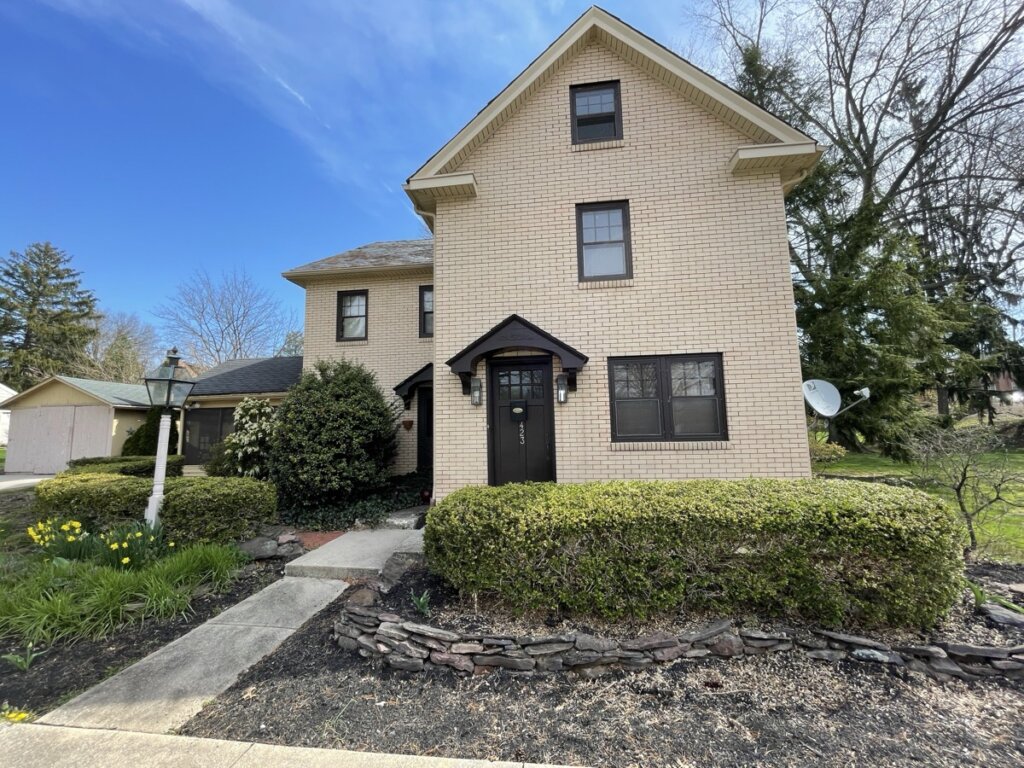
In the episode, Brian and Chris discuss a homeowner who worked with Austin Glanzer, co-owner of 717 Home Buyers, in Coatesville. Austin estimated the house needed painting, new carpet, countertop and kitchen work, and bathroom work to prepare it for the retail market.
| Part of the comparison | Amount or timing discussed |
|---|---|
| Potential value after improvements | About $300,000 |
| Austin’s estimated listing net after work and traditional selling expenses | About $245,000 |
| 717’s as-is cash offer | $207,000 |
| Difference between the estimated listing net and cash offer | About $38,000 |
| Austin’s estimated preparation and sale timeline | About two months of preparation; roughly three months overall |
The useful comparison was approximately $245,000 versus $207,000, rather than $300,000 versus $207,000. Listing still offered a meaningful potential financial advantage. The homeowner chose the cash option because reaching the higher estimate required upfront money, coordinating improvements, and more time.
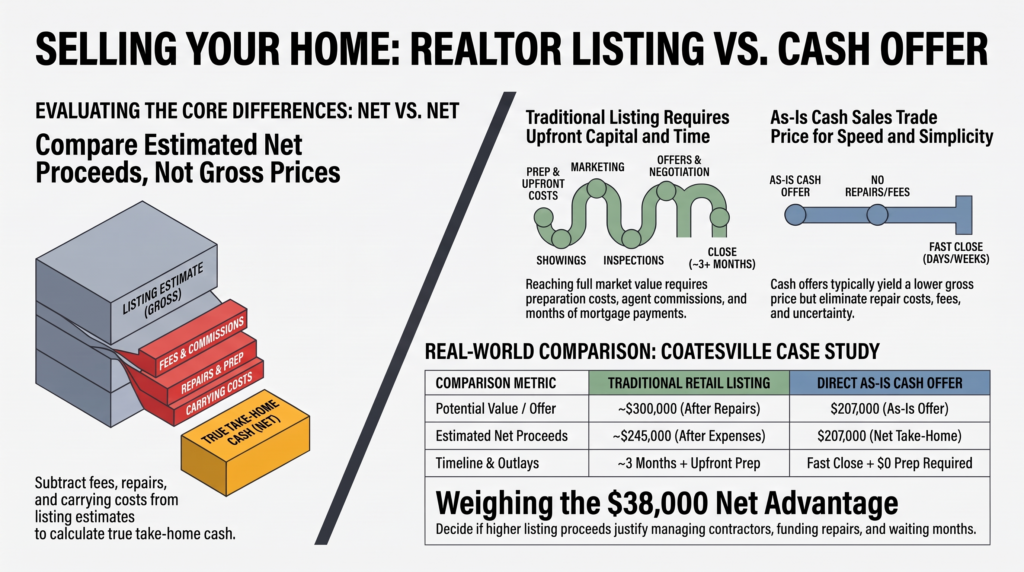
These are the estimates and offer discussed in the episode, not a verified final settlement statement. The episode does not itemize all deductions or establish the homeowner’s mortgage payoff, so neither number should be treated as confirmed cash deposited after every obligation. The timing was Austin’s estimate for this property, not a promise for other sellers.
Another homeowner could reasonably decide that a potential $38,000 gain justified the work. That is the point of comparing net proceeds: make the tradeoff visible instead of making either option look automatically better.
Build your own comparison without tilting the numbers
1. Match the expected price to the work you would actually do
Ask an agent familiar with your neighborhood to show which comparable sales support the estimate. A renovated home’s selling price is useful only if your plan and budget could bring your house to a comparable condition. Ask for both an as-is listing estimate and an estimate after specific improvements.
You do not have to choose only between a full renovation and a direct cash sale. Listing with limited preparation may be a useful third column. If choosing the work is your main uncertainty, our fix-or-sell-as-is discussion explores that separate decision. Here, the question is how each realistic plan changes what you keep.
2. Get a written estimate of the closing proceeds
Ask the agent and closing professional to itemize seller-paid charges, any agreed buyer credits, and mortgage or other payoffs. Use the compensation actually proposed in your agreement. The National Association of REALTORS® explains that agent compensation is negotiable and is not set by law; a fixed percentage from an older article is not your quote.
Our guide to selling-cost categories can help you prepare questions, but replace its example amounts and percentages with current written estimates for your sale.
For your loan, request a payoff amount for the anticipated closing date. The Consumer Financial Protection Bureau explains why a mortgage payoff can differ from the balance on your statement: it can include interest through the payoff date and other applicable charges. Use the appropriate date for each selling option.
3. Account for money you spend before settlement
A seller net sheet may focus on settlement rather than the entire selling project. Ask which expenses it includes. Add contractor payments, cleaning or preparation, and the carrying payments you expect to make from today until closing if they are not already accounted for.
Keep cash flow and cost accounting consistent. The CFPB explains that principal payments reduce your mortgage balance. If you subtract full mortgage payments made before closing, use the resulting lower payoff balance for that closing date. Have the closing professional reconcile escrow, tax prorations, and refunds so you do not count the same dollars twice.
Estimated overall cash result = estimated cash received at closing − selling-related cash paid before closing + related refunds not already included. Apply that calculation to both paths. Keep a separate note of when bills must be paid; money you might receive later cannot pay a contractor today.
4. Apply the same scrutiny to the cash offer
Ask the buyer to show what you would receive after any seller-paid charges and payoffs. Confirm who pays closing expenses, what property condition the offer assumes, and whether an inspection or other contingency could change the price. A cash purchase price is not automatically your take-home amount.
Certainty comes from the terms and the buyer’s ability to perform. For issues that can affect that estimate, see what can go wrong after accepting a cash offer.
5. Test a realistic range before choosing
Have the agent help you estimate a likely outcome and a more conservative one. Change only assumptions you can explain: a lower sale price, an additional month, or a repair quote that comes in higher. Do the same for any unresolved cash-offer deductions or conditions.
Hypothetical Lancaster example: Suppose your completed comparison shows $220,000 from listing and $200,000 from a direct sale after the costs included in each plan. Listing has a $20,000 advantage. If a revised contractor quote adds $6,000 that was not included before, that advantage becomes $14,000. The cash option has not become equal; the potential reward for doing the work has changed.
When the extra listing proceeds may be worth pursuing
Listing may make more sense when the expected advantage remains substantial under reasonable assumptions, the house needs little work, and you have the funds and flexibility to complete the sale. In the episode, Austin says he would probably recommend listing a house that is already very nice and does not need work.
A direct buyer needs room in the purchase price for the work, expenses, and resale plan. If you have already created that value, exposing the house to the open market may help you retain more of it.
An as-is cash sale may make more sense when a credible offer meets your needs and the additional projected listing proceeds do not justify the upfront spending or workload for you. It can also be worth comparing a lightly prepared listing before assuming you must fund a major renovation.
Convenience can justify accepting less, but it does not make two unequal dollar amounts equal. Keep the estimated financial difference visible, then weigh the practical demands against your circumstances.
Keep the local details and disclosure obligations in view
Use your own property’s numbers whether you are selling in Lancaster, York, Harrisburg, or Coatesville. The Coatesville estimate illustrates the method; it does not establish another neighborhood’s price, repair budget, or selling timeline.
For residential transfers covered by Pennsylvania’s Real Estate Seller Disclosure Law, sellers must disclose known material defects, with exceptions specified in the law. An as-is approach is not permission to conceal a known problem. Ask your agent or a Pennsylvania real estate attorney about the requirements for your transaction.
Watch the 7:50 conversation
Brian and Chris walk through Austin’s Coatesville example and the questions behind the numbers: how much you could keep, what you must spend first, and whether the extra time and work fit your life.

Leave the comparison with two written numbers and a clear next step
Ask a local agent for a supported selling-price estimate, a preparation plan, and a seller net sheet. Ask the cash buyer for an offer with the deductions and conditions explained. Add your pre-closing outlays to both comparisons and decide how much potential extra money would make the longer path worthwhile.
717 Home Buyers is a potential purchaser, so an independent agent’s estimate is a useful second perspective. Austin’s example shows why the best conversation leaves room for either answer.
Read the Podcast Transcript to Learn More
Brian: Hey, everybody. Welcome back to Central PA Property Talk, brought to you by 717 Home Buyers here in Lancaster, Pennsylvania. I’m Brian.
Chris: And I’m Chris. Today we’re answering a question a lot of homeowners wrestle with: Should I list my house with a Realtor, or sell it as-is for cash?
Brian: And the answer really depends on the house and the seller’s situation. If your house is in great condition, you have time, and your goal is getting the highest possible price through the open market, listing may make more sense.
Chris: That’s interesting coming from a cash home buyer.
Brian: But it’s true. A cash offer is usually going to be lower than what a house could potentially sell for after it’s repaired, prepared and marketed. The mistake is comparing a cash offer directly to a possible listing price.
Chris: Because the listing price isn’t necessarily what goes in your pocket.
will you realisticallyBrian: Exactly. The better comparison is net versus net. What are you realistically going to walk away with under each option, and what will it take to get there?
Chris: We actually have a recent example of that, right?
Brian: We do. Austin at 717 recently worked with a homeowner in Coatesville who was deciding between listing and taking a cash offer.
Chris: What was the house like?
Brian: It wasn’t in terrible condition, but Austin estimated it needed painting, new carpet, some countertop and kitchen work and some bathroom work to get it ready for the retail market.
Chris: And what were the numbers?
Brian: Austin estimated that if they did the work, the house could potentially be worth around $300,000.
Chris: Compared with what kind of cash offer?
Brian: 717 was able to offer $207,000 as-is.
Chris: Wow. So if I’m the homeowner, I see $300,000 versus $207,000 and think listing is the obvious choice.
Brian: And that’s exactly where you have to slow down. Austin’s estimate was that after doing the work and accounting for the expenses involved in selling traditionally, the homeowner might actually net around $245,000.
Chris: Okay. So now we’re really comparing roughly $245,000 with $207,000.
Brian: Right. Still a meaningful difference-about $38,000 based on Austin’s estimates. We’re not going to pretend the cash offer was financially equal.
Chris: So why did they choose cash?
Brian: Because getting to that potential $245,000 required money, work and time. Austin estimated they might spend around two months getting the property ready, followed by the listing and closing process. He thought it could be roughly three months before everything was finished.
Chris: Plus they’d have to pay for the improvements upfront.
Brian: Exactly. They’d have to coordinate the work, put money into the property, list it, deal with showings and potentially go through inspection negotiations. They decided getting $207,000 sooner and letting 717 take responsibility for the property made more sense for them.
Chris: But another homeowner could hear that and say, “For another $38,000, I’ll do the work and wait.”
Brian: Absolutely. And that homeowner should seriously consider listing.
Chris: So how should someone make this comparison?
Brian: Start with a realistic expected sale price based on the house’s current condition and what it would take to prepare it for the market. Then estimate your repairs and preparation costs. What does the house actually need? Paint and carpet? A kitchen? Bathrooms? A roof? A major cleanout?
Chris: Then selling expenses.
Brian: Right. Talk with the Realtor you’re considering and ask for an estimate of your likely selling expenses and net proceeds. Agent compensation is negotiable, so use the actual numbers being proposed rather than assuming some standard percentage.
Chris: What about the time involved?
Brian: That belongs in the calculation too. If you spend weeks preparing the house and then additional time marketing and closing, you may still have mortgage payments, taxes, insurance, utilities and maintenance during that period.
Chris: And a traditional buyer may have an inspection.
Brian: Depending on the agreement, yes. There can be inspection negotiations or other issues before closing. And Pennsylvania sellers generally have disclosure obligations for known material defects, subject to the exceptions in the law. Selling a house as-is doesn’t mean hiding a problem you know about.
Chris: So after estimating all of that, I have a more realistic listing net.
Brian: Right. Then put the cash offer beside it and find out what, if anything, would be deducted from that number. Now you’re comparing net to net.
Chris: But Austin says there are some things you can’t put neatly into a spreadsheet.
Brian: Definitely. He said homeowners also need to consider cash flow, time and their personal situation.
Chris: What does he mean by cash flow?
Brian: Maybe listing could potentially put more money in your pocket, but you need $20,000 or $30,000 upfront to get the house into that condition. If you don’t have that money-or simply don’t want to put more money into the house-that matters.
Chris: Austin also gave you a general range from what he sees, didn’t he?
Brian: He did, although this is his experience, not a rule for every house. He said he sometimes sees situations where homeowners might potentially make around $20,000 to $25,000 more by doing the work and going through the traditional selling process.
Chris: So when would Austin tell someone to list?
Brian: He was pretty straightforward about that. If the house is already very nice and doesn’t need work, he’d probably tell the homeowner to list it with a Realtor.
Chris: Why?
Brian: Because a home buyer like 717 has to buy at a price that leaves room to put money and work into the property and eventually resell it. Austin described that as creating sweat equity. If the homeowner has already done the work, listing may allow them to capture more of that value themselves.
Chris: So when does the cash option become more attractive?
Brian: When the house needs meaningful work, when the seller doesn’t have or doesn’t want to invest the cash to fix it, when they need their proceeds sooner, or when avoiding the repairs, preparation, showings and uncertainty is worth accepting less.
Chris: And that’s really the decision, isn’t it? Not just, “Which number is bigger?”
Brian: Exactly. Ask: What am I likely to net if I list? What will I net from the cash offer? How much money do I have to put into the property first? How long will each option take? And what work and uncertainty come with each path?
Chris: Then decide whether that difference is worth it to you.
Brian: Right. For one homeowner, spending the money, doing the work and waiting a few months for another $25,000 or $30,000 could absolutely make sense.
Chris: For somebody else, it might not.
Brian: And Austin summed that up pretty well: “Sometimes time is money.”
Chris: So if you’re trying to decide between listing your Central Pennsylvania house and selling it as-is, get real numbers for both options.
Brian: Talk with a good local real estate agent. Find out what the house could realistically sell for, what they recommend doing before listing, what those improvements may cost, and what your estimated net proceeds could be.
Chris: And if you want an as-is option to compare against it?
Brian: Call 717 Home Buyers and get a cash offer. You don’t have to accept it. Put the numbers side by side and decide which option makes the most sense for you.
Chris: Net versus net.
Brian: Net versus net-and then consider the time, work, cash flow and certainty. If you’d like an as-is cash offer to compare with your other options, call 717 Home Buyers at 717-321-SOLD or visit 717homebuyers.com.
Want an as-is offer to put beside your listing estimate?
717 Home Buyers can discuss your property and provide an as-is offer for you to evaluate. We can walk through the price, any deductions, and the proposed timing so you have another option to compare.
Call 717-321-SOLD or request a cash offer. You can also review our overview of listing versus selling directly.
You do not have to accept an offer. Compare it with your agent’s numbers and choose the path that makes the most sense for you.