

Selling a House During Divorce in Lancaster, PA: Should You List or Sell for Cash?

If you need to sell a house during a divorce in Lancaster, Pennsylvania, you generally have three choices: one spouse keeps the house, you list the property with a real estate agent, or you sell it directly to a cash home buyer.
Listing usually makes the most sense when the house is in good condition, both spouses can cooperate through the traditional sales process, and the additional net proceeds justify the extra time and work. An as-is cash sale may make more sense when the property needs repairs or cleanout, you want to avoid showings and commissions, or both spouses want a more predictable closing and a clean financial break from the property.
The key is to compare the right numbers.
Don’t compare a Realtor’s suggested listing price directly with a cash offer. Compare what you are likely to walk away with after repairs, selling expenses, carrying costs, and the time required for each option.
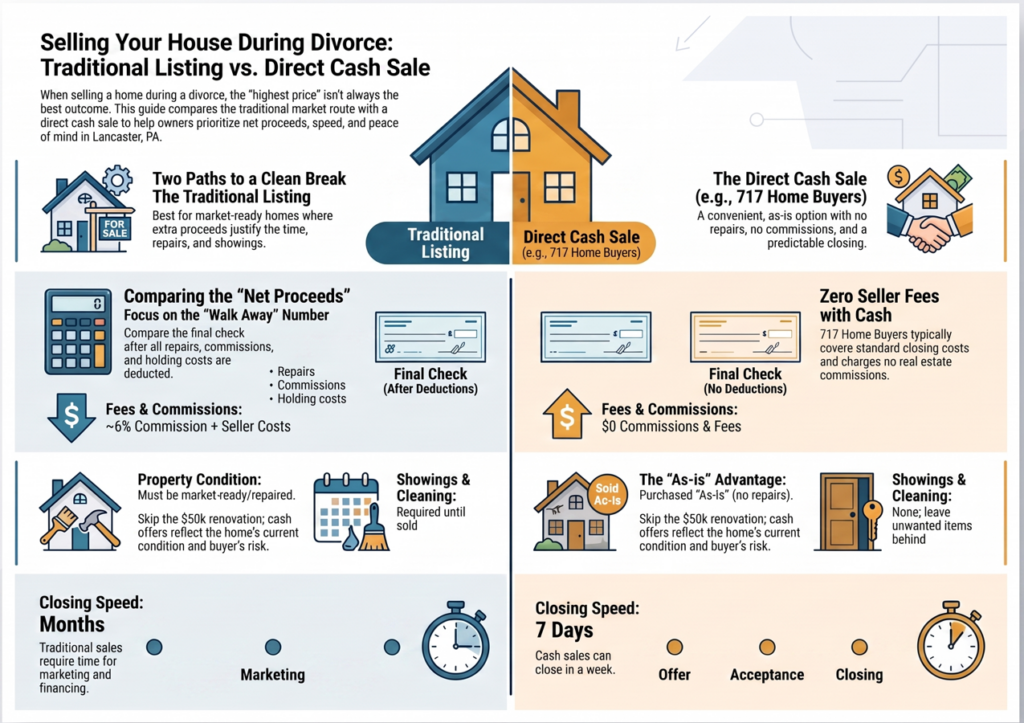
With 717 Home Buyers, the property can be purchased as-is with no commissions or seller fees, and in most cases 717 covers standard closing costs. A straightforward transaction can sometimes close in as little as seven days. If listing the house is likely to leave you substantially more money after expenses, however, listing may still be the better choice.
Here is how to decide.
Should We List the House or Sell It for Cash?
Start by getting realistic numbers for both options.
For a traditional sale, determine what the house is reasonably likely to sell for in its current condition—or after whatever repairs and preparation you plan to complete. Then estimate what you would actually have left after getting the property ready and completing the sale.
For an as-is sale, get a written cash offer and find out what will be deducted from that amount at closing.
Suppose, hypothetically, that a Lancaster home could sell for $400,000 after it is cleaned out, repaired, prepared for the market, and successfully sold to a traditional buyer. A cash buyer isn’t likely to offer the same $400,000 for the house as-is. The cash buyer has to account for repairs, holding expenses, resale costs, and the risk involved in purchasing the property.
Austin Glanzer and the team at 717 Home Buyers consider factors such as recent comparable sales, property condition, anticipated repairs, and the costs 717 expects to take on after buying the home when determining an offer.
The question for the homeowners is whether the difference is worth it.
If listing is realistically going to leave the two of you $150,000 or $200,000 more after all expenses, and the house is relatively easy to sell, putting up with the longer traditional process may make very good financial sense.
If the difference after repairs, selling expenses, and carrying costs is closer to $20,000 or $25,000, you might make a different decision. Avoiding the repairs, preparation, showings, negotiations, and additional months of ownership could be worth that difference to you.
Those numbers are only hypothetical examples. The point is the comparison:
The highest sale price is not necessarily the option that leaves you with the most money—or the option that makes the most sense for your situation.
You can learn more about the two approaches in 717 Home Buyers’ comparison of selling on the MLS versus a direct sale in Lancaster.
What Will a Traditional Sale Actually Cost?
If the house is updated, doesn’t need significant repairs, and should appeal to traditional buyers, listing with a good local real estate agent may be the best way to maximize the sale price.
But start with the likely net proceeds, not the suggested listing price.
Depending on the property and transaction, a traditional sale can involve repairs or improvements, cleaning and removing belongings, negotiated real estate compensation, seller closing expenses, inspection-related repairs or credits, mortgage and lien payoffs, and the cost of continuing to own the property until closing.
There is also work involved that doesn’t show up on a closing statement.

Someone needs to decide which repairs to make, get the house ready, coordinate access and showings, evaluate offers, respond to inspection requests, and make decisions when something changes during the transaction.
During a divorce, many of those decisions may require communication and cooperation between two people who would rather be finished dealing with the house.
That inconvenience doesn’t automatically make a cash sale better. It simply has a value.
If the additional net proceeds from listing clearly outweigh the additional work, expense, and time, listing may be the better financial decision.
What Is Different About Selling the House As-Is to 717 Home Buyers?
A direct sale to 717 Home Buyers removes many of the steps involved in putting a house on the traditional market.
717 purchases the property directly. You don’t have to repair or upgrade the house first. You don’t have to prepare it for showings, and unwanted belongings can generally be left behind.
717 Home Buyers doesn’t charge a real estate commission or seller fee. In most transactions, 717 also covers the standard closing costs.
The sale still goes through a title company. If there is an existing mortgage, it is paid off through the closing. Liens or other obligations that legally must be satisfied from the transaction also have to be addressed. The remaining proceeds are then available to the sellers and can be distributed according to their agreement, divorce settlement, or applicable court order.
Because 717 is purchasing with cash rather than making the sale dependent on a traditional buyer obtaining mortgage financing, there are fewer moving pieces between accepting the offer and closing.
You can review the full 717 Home Buyers buying process before deciding whether getting an offer makes sense.
How Fast Can You Sell a House During a Divorce?
A straightforward cash transaction can sometimes close in as little as seven days, but seven days should not be treated as a guarantee.
If the title is clear, ownership is established, everyone who needs to sign is prepared to do so, and there are no legal issues preventing the sale, a cash transaction can move quickly.
Divorce-related property sales can also have complications that make a longer timeline necessary. Title issues, liens, questions about who has authority to sell, or an unresolved disagreement between spouses can all affect closing.
A fast closing can be valuable when the house is costing money every month for the mortgage, utilities, insurance, taxes, or maintenance. It can also help when neither spouse wants to put additional money into the property.
But not everybody needs a seven-day closing.
Maybe you need 30 days. Maybe you need more time because someone is still living in the house. Or maybe there is no financial reason to rush and waiting for a traditional buyer is likely to produce substantially greater net proceeds.
The best closing date is the one that fits your situation—not necessarily the fastest date available.
How Does the Condition of the House Change the Decision?
Property condition can completely change which option makes more sense.
Consider a clean, updated Lancaster home with functioning major systems, no significant deferred maintenance, and little work needed before listing. If the house is likely to attract traditional buyers without requiring much additional money or effort, there may be little reason to accept a substantially lower investor offer simply for convenience.
That is a house where talking with a good local real estate agent may make sense.
Now consider an older property that needs a roof, electrical work, kitchen or bathroom updates, significant cleanout, or other repairs.
You can still list that house. But before doing so, determine how much money and time you are willing to put into it and whether those improvements are likely to return enough additional money to justify them.
With 717 Home Buyers, you don’t have to complete those repairs first. The offer reflects the property’s current condition, and 717 assumes responsibility for the repairs and work after purchasing it.
That creates a fairly simple tradeoff:
With a traditional sale, you may do more work and accept more uncertainty in pursuit of a higher net return. With an as-is sale, you accept a price that reflects the work and risk the buyer will take on after closing.
Neither approach is automatically better.
How Do You Compare the Actual Net Proceeds?
This is probably the most useful calculation you can make before deciding how to sell.
For the traditional-sale option, start with a realistic expected selling price and subtract the money you expect to spend getting from where the house is today to a completed closing.
That may include repairs, preparation, negotiated real estate compensation, seller expenses, concessions, and additional carrying costs while the property is being prepared and marketed.
Then calculate the cash-sale option.
Start with the written offer. Determine what, if anything, will be deducted from that offer other than obligations attached to the property or transaction that must legally be paid, such as an existing mortgage or liens.
Now put those two net numbers next to each other.
For example, don’t ask:
“Could we list this house for $400,000 instead of accepting a lower cash offer?”
Ask:
“After everything required to get each transaction to closing, how much money are we likely to have left to divide?”
That is a much more useful number.
717 Home Buyers provides another breakdown of the differences between the two approaches on its traditional sale versus direct cash sale comparison.
Do Both Spouses Have to Agree to Sell the House?
In many divorce-related home sales, the safest practical starting point is to make sure both spouses are on board before the property goes under agreement.
Pennsylvania law generally presumes that property acquired by either spouse during the marriage is marital property, subject to important exceptions. That is true even when title is held in only one spouse’s name. Pennsylvania is also an equitable-distribution state, so marital property is divided in a manner the court determines to be equitable rather than automatically 50/50.
But marital-property status and legal title are not exactly the same thing. That distinction matters when determining who must actually sign a deed.
If both spouses own the house as tenants by the entireties, as is common for married couples who own a Pennsylvania home together, one spouse generally cannot sell the entire property without the other spouse joining in the conveyance. A court order, divorce decree, or enforceable property agreement can also affect who has authority to sell and what must happen to the proceeds.
A house acquired during the marriage but titled differently can present a different legal situation. That’s why a buyer or title company needs to examine the deed, marital status, divorce proceedings, and any applicable agreements or court orders rather than simply assuming that one signature—or two—is always sufficient.
For homeowners, the practical rule is:
Before signing an agreement to sell the house, make sure both spouses are on board whenever possible, and have the title company or your attorney confirm exactly whose signatures are legally required. If a divorce agreement or court order gives one spouse authority to proceed, provide that documentation early so it can be reviewed before closing.
717 Home Buyers—or any other home buyer or real estate agent—cannot resolve a legal disagreement between spouses. If there is a dispute about ownership, whether the house can be sold, how the proceeds will be distributed, or a court order affecting the property, that question belongs with your Pennsylvania divorce attorney.
Lancaster County provides local information about divorce filings and related procedures, and Pennsylvania’s rules regarding marital property and equitable distribution are contained in the state’s Divorce Code.
What Happens to the Mortgage When You Sell?
If there is still a mortgage on the property, selling the house does not mean you simply divide the entire sale price.
The mortgage generally has to be paid off as part of the closing process. The title company obtains the necessary payoff information and handles the appropriate disbursements at closing.
The same general issue applies if there are liens or other obligations that have to be satisfied before clear title can be transferred.
What remains after the required payoffs and transaction expenses is the net equity available from the sale.
How that money is ultimately divided between divorcing spouses is a separate issue. It may be governed by an agreement between the spouses, a marital settlement agreement, or a court order.
A cash home buyer can purchase the property and a title company can complete the real estate closing, but neither determines how divorcing spouses are legally entitled to divide their marital property.
What About Capital Gains Taxes When Selling During a Divorce?
Many homeowners qualify for a federal exclusion on gain from the sale of their principal residence.
Generally, an eligible individual may exclude up to $250,000 of gain. Certain married couples filing a joint return may qualify for an exclusion of up to $500,000, provided the applicable requirements are satisfied.
Divorce makes the issue more nuanced than simply saying the exclusion gets cut in half once a divorce becomes final.
The IRS has special rules that can affect ownership and use of a principal residence by separated or divorced spouses. There are also special tax rules involving transfers of property between spouses or former spouses incident to divorce.
So don’t choose a closing date based on a blanket assumption that you must sell before the divorce is final to preserve a particular tax exclusion.
If the home has appreciated substantially, was previously used as a rental, was owned by one spouse before the marriage, or could generate a significant taxable gain, talk with a CPA or qualified tax professional before deciding when to sell.
The IRS explains the basic home-sale exclusion in Topic No. 701, Sale of Your Home and provides more detailed guidance in Publication 523, Selling Your Home.
Do’s and Don’ts When Selling a House During a Divorce
Do get realistic numbers for both options. A Realtor can help estimate a likely traditional-market sale, and a direct buyer can provide an actual cash offer to compare with it.
Do compare net proceeds instead of headline prices. What matters is what remains after the house is actually sold.
Do make sure both spouses know a sale is being considered and determine early who will legally need to sign. If an agreement or court order affects the sale, get it to the attorney or title company early.
Do consider the condition of the house. A market-ready property and a house needing $50,000 worth of work shouldn’t be evaluated the same way.
Do find out about mortgages, liens, title issues, and required signatures early. Discovering a problem shortly before closing can delay either type of sale.
Do decide what convenience is actually worth to you. Avoiding repairs, showings, negotiations, and months of carrying costs has value—but that value is different for every homeowner.
Don’t assume a cash sale is automatically better because you’re getting divorced. If listing will put substantially more money in your pockets and the process is manageable, listing may be the smarter choice.
Don’t assume the highest possible selling price is automatically the best deal. Look at the money and work required to reach that price.
Don’t spend thousands of dollars repairing the property before determining whether those repairs are likely to produce enough additional net proceeds to justify them.
Don’t accept a lower offer solely because someone promises a fast closing. Speed matters only when it solves a problem or has enough financial value to justify the difference.
Don’t rely on a cash buyer, real estate agent, or online article for legal or tax advice. Use the appropriate Pennsylvania attorney or qualified tax professional when those issues affect the decision.
So, Should You List the House or Sell It to 717 Home Buyers?
If your Lancaster-area house is in good condition, needs little work, and both spouses are able to cooperate through the traditional selling process, start by finding out what a good local real estate agent believes the property can realistically sell for.
Then calculate the likely net proceeds.
If the additional amount you would receive by listing is substantial enough to justify the repairs, preparation, showings, negotiations, longer timeline, and possibility of inspection or financing issues, listing may be the better decision.
If the house needs repairs, has belongings to remove, or you simply want to know what you could receive without preparing it for the market, get an as-is cash offer from 717 Home Buyers as the second number in your comparison.
There is no obligation to accept it.
With 717, you can sell the property as-is, there are no real estate commissions or seller fees charged by 717, and in most transactions 717 covers standard closing costs. A straightforward sale can sometimes close in as little as seven days.
Then put the two realistic net numbers next to each other.
If listing leaves you substantially more money and the additional work is manageable, list it.
If the difference isn’t enough to justify the repairs, carrying costs, showings, coordination, and uncertainty, the direct sale may make more sense.
The goal isn’t simply to sell a house during a divorce as fast as possible. The goal is to choose the way of selling that makes the most financial and practical sense for the property you actually own.
717 Home Buyers is a local Central Pennsylvania home buyer based in Lancaster. You can learn more about how the cash-sale process works, compare selling directly with a traditional listing, or call 717-321-SOLD (717-321-7653) to discuss the property and request a no-obligation offer.
This article provides general information about selling real estate during a divorce in Pennsylvania. It is not legal or tax advice. You should discuss questions about ownership rights, equitable distribution, required signatures, court orders, or tax consequences with the appropriate Pennsylvania attorney or qualified tax professional.