

Auction or Cash Sale in Pennsylvania? Start With the Net Result
Selling at auction can make sense when a Pennsylvania property is likely to attract competitive bidding and you are comfortable with the auction’s costs, terms, preparation, and uncertainty. An as-is cash sale may make more sense when you value a known offer, less repair or cleanout work, and a more predictable path to closing. A traditional listing may still be the strongest option when the home’s condition, your timeline, and likely retail value justify exposing it to the broader market.
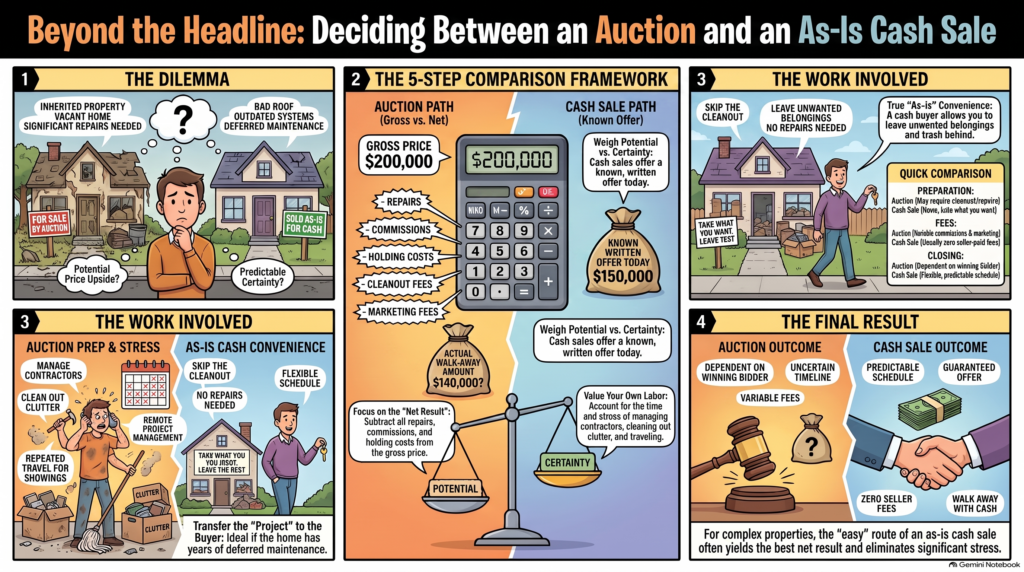
The key is not simply asking which method could produce the highest sale price. Compare the price, costs, work, timing, and certainty of each realistic option and look at what you are likely to walk away with when the sale is actually finished.
That distinction is especially important with an older house, inherited property, vacant home, rental, or house that needs significant repairs or cleanout. In those situations, the selling method with the highest possible price and the selling method with the best overall result are not always the same.

Auction vs. Listing vs. As-Is Cash Sale: A Quick Comparison
| What to compare | Real estate auction | Traditional listing | As-is cash sale |
|---|---|---|---|
| Price | Competitive bidding can create upside, but the final result depends on bidder interest and the auction terms. | Broad exposure to retail buyers may help pursue a higher market price. | You receive an actual offer to evaluate before deciding whether to sell. |
| Costs | Seller charges and auction compensation vary by contract. Marketing and other charges may also apply. | Costs can include agent compensation, preparation, repairs, concessions, carrying expenses, and transaction costs. | Costs depend on the buyer and written agreement. Ask exactly which expenses, if any, come out of your proceeds. |
| Work | Preparation, access, personal-property decisions, and other work depend on the auction plan. | Cleaning, repairs, staging, showings, inspections, and negotiations may be part of the process. | A true as-is purchase can eliminate much of the repair work and, in some situations, significant cleanout. |
| Timing | You have a scheduled auction process, but marketing, preparation, and closing still take time. | Timing depends on preparation, market response, negotiations, inspections, financing, appraisal, and closing. | A cash buyer may be able to offer a more flexible and predictable closing schedule, assuming title and other closing requirements are resolved. |
| Certainty | The outcome depends on bidding and the specific terms you agreed to. | A signed sale can still involve financing, inspection, appraisal, or other contingencies. | You can evaluate a known written offer, but you should still review contingencies and understand whether the price can change. |
There is no single best way to sell every Pennsylvania house. The right choice depends on your property, your financial goals, the work you are willing to do, and how much uncertainty you are comfortable accepting.
Who Should Seriously Compare These Three Selling Options?
You do not need to have an inherited property or a house in terrible condition for this comparison to be useful. It is worth comparing an auction, traditional listing, and direct as-is sale when the property itself is creating a difficult decision.
- You own an older home with deferred maintenance or expensive repairs.
- You inherited a house and are deciding how much work to put into it before selling.
- You live outside Central Pennsylvania and do not want to manage contractors and cleanout from a distance.
- The property is vacant and continuing to carry it is becoming a burden.
- You own a rental that needs substantial work before another tenant or retail buyer would want it.
- The house contains furniture, belongings, or significant clutter that still has to be addressed.
- You want the strongest financial result but are not sure how much time, money, and risk you should take on to pursue it.
If the house is already in good condition, you have plenty of time, and preparing it for retail buyers is not a problem, a traditional listing may deserve especially serious consideration. The purpose of comparing your options is not to steer every property toward the same solution.
How Does Selling a House at Auction Work in Pennsylvania?
A real estate auction sells property by soliciting competing bids rather than negotiating with one buyer at a time. Pennsylvania law recognizes multiple auction methods, including live, online, real-time, extended, and combinations of those formats.
The Pennsylvania State Board of Auctioneer Examiners regulates the practice and licensure of auctioneers and auction companies in the Commonwealth. Pennsylvania’s Auctioneer Licensing and Trading Assistant Registration Act also establishes licensing requirements and rules for conducting auctions.
One rule is especially important for a homeowner comparing auction companies: Section 15.1 of the Pennsylvania auction law generally requires a licensee or registrant to enter into a written contract with the owner or consignor before conducting the transaction. That agreement must contain the terms and conditions under which the sale will be conducted and the applicable license or registration number.
That means the written auction agreement matters at least as much as the promise of competitive bidding. You need to understand what you are agreeing to before the property goes to auction.
8 questions to ask before putting your Pennsylvania house up for auction
- What will I pay? Ask about auctioneer compensation, marketing charges, administrative costs, and any other seller-paid expenses in the agreement.
- Is there a buyer’s premium? If so, ask how it works and how the auction company believes it could affect bidding on your property.
- What happens if the bidding is lower than I expect? Do not wait until auction day to learn what your contract requires.
- What do terms such as reserve, minimum bid, absolute auction, or seller confirmation mean in this particular agreement? Have the auction professional explain the consequences clearly.
- What work do I have to complete beforehand? Ask about repairs, cleanout, access, photography, inspections, personal property, and preparation.
- What happens if the property does not sell? Find out whether you still owe particular charges and what happens next.
- When is the buyer expected to close? Understand deposits, closing requirements, and what happens if the winning bidder does not perform.
- Under exactly what circumstances am I obligated to sell? Read the agreement carefully and get professional advice if a term is unclear.
If you want to go deeper into auction-specific legal considerations, see our guide to legal pitfalls to consider when selling a Pennsylvania home at auction.
How Much Does It Cost to Sell a House at Auction in Pennsylvania?
There is no single Pennsylvania auction commission or fee percentage that every homeowner pays. Costs depend on the auction company, the property, the marketing plan, and the contract you negotiate.
That is why it can be misleading to compare a cash offer or listing estimate with an auction’s possible sale price without first getting the actual auction terms.
Potential items to ask about include:
- auctioneer or auction-company compensation;
- advertising and marketing charges;
- photography, signs, online promotion, or platform-related expenses;
- property preparation or cleanout you are responsible for;
- seller closing or settlement expenses that apply to your transaction;
- costs you may still owe if the property does not sell; and
- carrying costs while you prepare, market, auction, and close the property.
Do not assume every item on that list applies to every auction. Instead, use it as a checklist and ask the auction professional to show you exactly what your agreement requires.
For a broader look at expenses that can change a seller’s bottom line, see our guide to the costs of selling an older Pennsylvania home versus selling as-is.
Can Selling at Auction Get You More Money?
It can, but competitive bidding creates an opportunity for a higher price, not a guarantee. If several motivated buyers want the same property, bidding can move upward. That potential upside is one of the strongest reasons a homeowner may consider an auction.
But the final result depends on the property, bidder interest, local demand, marketing, property condition, and the auction terms. That is why the most useful question is not simply, “What could my house sell for?”
A better question is:
What am I realistically likely to walk away with, what do I have to do to get there, how long could it take, and how much uncertainty am I willing to accept?
How Do You Compare an Auction Price With a Cash Offer?
Compare the net result, not just the largest headline number.
A higher gross sale price can still leave you with a less attractive overall outcome if reaching that price requires substantial repairs, cleanout, transaction costs, months of carrying expenses, and a large amount of your time.
Use this 5-step comparison
- Price: Start with a realistic sale price or actual written offer. Do not use an optimistic best-case number simply because it sounds attractive.
- Costs: Subtract the expenses that apply to each option. Include seller-paid transaction expenses, repairs, preparation, cleanout, and carrying costs where applicable.
- Work: Write down what you personally have to do. Coordinating contractors, emptying a house, driving back and forth, and managing access all have value even if they never appear on a settlement statement.
- Timing: Estimate how long each path realistically takes from today’s condition to closing. Include preparation before the property can even be marketed.
- Certainty: Identify what could still change the price, delay closing, or prevent the sale. Read every agreement rather than assuming an auction, listing, or cash sale is automatically guaranteed.
The highest potential sale price is not necessarily the highest net result. For some homeowners the extra work is worth it. For others, transferring repairs, cleanout, time, and uncertainty to the buyer is valuable enough to justify a lower gross price.
A Real Central Pennsylvania Example: Roger’s Inherited House
Austin from 717 Home Buyers recently spoke with a homeowner we’ll call Roger. That is not his real name, and identifying details have been left out for privacy.
Roger had inherited an older Pennsylvania property but lived out of town. The house needed considerable work, and there was a substantial amount of clutter and personal property still inside.
He was considering an auction for a perfectly understandable reason: competitive bidding might produce a strong price.
But that was only part of the decision.
Roger also had to decide how much of a project he wanted to manage from a distance. Would he need to clean everything out? Make repairs? Travel back and forth? Carry the property longer? What would the auction cost? What would happen under the auction agreement if bidding did not produce the result he wanted?
The alternative he was comparing was an as-is cash sale where he could take the possessions he wanted and potentially leave much of the remaining repair and cleanout work behind.
The lesson from Roger’s situation is not that an inherited house should automatically be sold for cash. It is that a seller should compare the financial outcome with the work, distance, time, and uncertainty required to reach that outcome.
When Does an As-Is Cash Sale Make More Sense?
An as-is cash sale becomes more attractive when the condition of the property or the work required to sell it is a major part of your problem.
An as-is cash sale may be worth comparing when:
- the roof, plumbing, electrical system, foundation, HVAC, kitchen, or other major components need work;
- the house has years of deferred maintenance;
- there is significant furniture, trash, or personal property to remove;
- you inherited the home and do not want to renovate it before selling;
- you live several hours away or outside Pennsylvania;
- the property is vacant and you want to reduce the amount of time you remain responsible for it;
- you own a rental you no longer want to repair and manage; or
- certainty and simplicity matter almost as much as maximizing price.
If repairs are the main question, our guide to deciding whether you should fix the house or sell it as-is looks more closely at that tradeoff.
There is also an important tradeoff to acknowledge: a direct buyer purchasing a difficult property as-is is taking on repairs, cleanout, holding costs, and resale risk after the purchase. A homeowner should not assume an as-is cash offer will equal the highest price a renovated home might eventually bring on the retail market.
The value is that you can evaluate an actual offer alongside the expenses and work you may be avoiding.
When Is Listing With a Real Estate Agent the Better Choice?
Listing may be the better choice when your property is in reasonably marketable condition, you have enough time, and exposing the home to traditional buyers is likely to produce a meaningfully stronger net result.
That can include a house that is already move-in ready. It can also include a property where a manageable amount of repair or preparation is likely to pay for itself.
If you are financially and emotionally comfortable doing the work, waiting through the sale process, and dealing with showings and negotiations, do not dismiss the retail market just because a direct sale is easier.
A good local real estate agent should be able to help you estimate a realistic listing range and discuss what preparation would be needed. That gives you another real option to put beside the auction terms and any direct cash offer.
You can also review 717 Home Buyers’ comparison of common home-selling options as a starting point.
What Does “As-Is” Mean When Selling a Pennsylvania House?
In practical terms, an as-is sale generally means the buyer is accepting the property’s present physical condition instead of requiring the seller to complete agreed repairs before closing.
“As-is” does not automatically erase every legal duty or every term in the purchase agreement. The written contract and Pennsylvania law still matter.
However, when you are dealing with us at 717 Home Buyers, if we make you an “as-is” offer, it means “as-is.” That means no cleanup, no repairs, no landscaping, no painting, and no inspection. We assume the risk and you walk away!
When comparing direct buyers, ask what “as-is” means in that company’s actual agreement. Can the price change after an inspection? Are you expected to empty the house? Who pays which closing expenses? What contingencies remain? What happens if the buyer decides not to proceed?
If you want to understand the direct-sale process itself before comparing it with an auction, read how the cash home-buying process works in Pennsylvania.
When you are dealing with us at 717 Home Buyers, if we make you an “as-is” offer, it means “as-is.” That means no cleanup, no repairs, no landscaping, no painting, and no inspection. We assume the risk, and you walk away with your cash!
What If You Inherited the House?
An inherited property can create questions that need to be answered before the auction-versus-cash decision even begins. The first issue may be who actually has authority to sell the house.
Pennsylvania’s auction licensing law contains an exemption from its licensing requirement for a sale conducted in the settlement of a decedent’s estate by the executor or administrator. Pennsylvania’s Real Estate Seller Disclosure Law also lists certain transfers by a fiduciary in the administration of a decedent’s estate, guardianship, conservatorship, or trust among its exceptions.
Those are specific statutory exceptions, not a blanket rule that every property someone calls “inherited” is exempt from licensing or disclosure requirements. The facts of the estate and the person conducting or transferring the property matter.
You can review Pennsylvania’s Real Estate Seller Disclosure Law. If you are uncertain about estate authority, probate, title, or disclosure obligations, speak with a qualified Pennsylvania attorney or other appropriate professional about your situation.
For a homeowner-focused overview, see our guide to probate and selling an inherited house in Pennsylvania.
5 Situations Where Comparing All Three Options Can Prevent a Bad Decision
- An older house that needs major updating. A higher retail value can look attractive until you calculate what it takes to get the property into retail condition.
- An inherited property with belongings still inside. The sale is only one part of the project; ownership, estate administration, cleanout, and family decisions may matter too.
- A vacant house. Every additional month can mean more taxes, insurance, utilities, lawn care, maintenance, and responsibility.
- An out-of-town owner. The best theoretical selling method may be much less attractive if it requires repeated travel and remote project management.
- A property with clutter and deferred maintenance. Before spending months solving every problem yourself, calculate what your likely net result would be if someone else took those problems on.
How to Decide: Auction, Listing, or Cash Buyer?
If you remember only one part of this guide, make it this decision framework:
- Consider an auction when the property may attract motivated competing bidders, you understand the written auction terms and costs, and you are comfortable with the uncertainty involved.
- Consider a traditional listing when the house is marketable or you are willing to improve it, you have time, and broad retail-market exposure could produce a stronger net result.
- Consider an as-is cash sale when repairs, cleanout, distance, timing, simplicity, or certainty are important enough that transferring those responsibilities to the buyer has real value to you.
If all three are realistic, compare all three. A homeowner is in a much better position to make a decision when there is an actual cash offer, a realistic opinion of the retail market, and clearly explained auction terms on the table instead of assumptions about what each route might produce.
Watch: Auction vs. “As-Is” Cash Sale in Pennsylvania
In this episode of Central PA Property Talk, Brian and Chris walk through the same decision using the five factors of price, costs, work, timing, and certainty. They also discuss Austin’s real conversation with the homeowner we’re calling Roger and why his out-of-town inherited property made the tradeoffs especially clear.

The Bottom Line: Compare What You Keep, What You Do, and What You Risk
An auction can be a strong option for the right property and seller. A traditional listing can produce a better result when the retail market justifies the work and time involved. An as-is cash sale can be valuable when the condition of the house, cleanout, distance, timing, or certainty is a major part of the problem.
The goal is not to pick the selling method with the most exciting headline. It is to choose the option that produces the best overall outcome for you.
Compare price. Compare costs. Compare work. Compare timing. Compare certainty. Then decide which tradeoff fits your property and your life.
Read the Podcast Transcript to Learn More
Brian: If you own a house in Pennsylvania that needs work and you’re thinking about selling it at auction, how do you know if that’s actually your best option? Could competitive bidding get you a better price? Would listing it with an agent make more sense? Or would you be better off taking a certain as-is cash offer and being done with the property? Welcome to the Central PA Property Talk Podcast from 717 Home Buyers, serving Lancaster, York, Harrisburg, Lebanon, Reading, and communities across Central Pennsylvania. I’m your host, Brian, here with my co-host Chris.
Chris: And I think auction is one of those options that sounds pretty appealing when you first hear it. Put the house out there, get a bunch of people bidding against each other, and hopefully the price keeps going up.
Brian: Sure. And sometimes that can work really well. I don’t want this conversation to turn into “auctions are bad and cash buyers are good,” because that’s not true. Pennsylvania regulates auctioneers and auction companies through the State Board of Auctioneer Examiners, and auctions are a legitimate way to sell real estate here.
Chris: So what should a homeowner be looking at?
Brian: I think the mistake is asking only one question: “Which option could produce the highest sale price?” The better question is, “Which option gives me the best overall outcome after I consider the price, the costs, the work I have to do, the timing, and the certainty?”
Chris: Because the highest number somebody talks about at the beginning isn’t necessarily the amount you end up with.
Brian: Exactly. And Austin recently had a conversation with a homeowner that illustrates this really well. We’ll call him Roger. That’s not his real name, and we’re leaving out identifying details.
Chris: What was going on with his house?
Brian: Roger had inherited an older property here in Pennsylvania, but he lived out of town. The house needed quite a bit of work, and there was also a lot of clutter and personal property inside that somebody was going to have to deal with.
Chris: So he wasn’t just deciding how to sell a house. He was deciding how much of a project he wanted to take on from a distance.
Brian: That’s exactly it. Roger had been looking into an auction because, naturally, he was hoping competitive bidding could get him the highest price. But he was also looking at an as-is cash sale where he could take the things he wanted from the house and potentially leave the rest behind rather than arranging a major cleanout and a bunch of repairs.
Chris: And I’m guessing Austin didn’t just tell him, “Take the cash offer.”
Brian: No. The conversation was really about understanding what Roger was comparing. If you’re considering an auction, start by understanding how that particular auction is going to work.
Chris: Aren’t all real estate auctions basically the same?
Brian: No, and that’s important. Pennsylvania law recognizes different auction formats, including live and online auctions. And if you’re working with a licensed auctioneer or auction company, Pennsylvania law generally requires a written contract with the property owner that spells out the terms and conditions for conducting the sale.
Chris: So that contract is something you really need to read.
Brian: Absolutely. Ask about the seller’s costs. Ask how the property will be marketed. Ask about the auction terms and what happens if the bidding doesn’t produce the result you’re hoping for. Ask what you’re responsible for before the auction and before closing. And don’t assume there’s one standard auction commission or fee structure that applies to every Pennsylvania home sale.
Chris: What about a reserve? People hear “reserve auction” and “absolute auction.” How does that fit in?
Brian: That’s another reason to get the specific terms explained to you rather than assuming you know what will happen. If an auction company talks about a reserve, minimum bid, absolute auction, seller confirmation, or any other condition, ask exactly what that means for your property and what happens under each possible outcome.
Chris: So the certainty question Austin raised with Roger is pretty important.
Brian: Very important. Think about somebody who has an older house with a bad roof, an outdated kitchen, a basement full of stuff, or a property that’s been sitting vacant. It doesn’t have to be inherited. Maybe you’ve owned it for 30 years. Maybe it was a rental. Maybe a family member moved into assisted living. Maybe you moved away and never got around to fixing the house up.
Chris: Those homeowners could all be looking at the same basic choice Roger was.
Brian: Right. Do I invest more time and money into this property and try to maximize what I can get? Do I put it in an auction and see what the market produces? Do I fix it up and list it with an agent? Or do I accept less potential upside in exchange for a more predictable as-is sale?
Chris: I like the phrase “potential upside,” because that seems to be the attraction of an auction.
Brian: It can be. Competitive bidding can be attractive, especially if the property is likely to generate interest from multiple motivated buyers. Pennsylvania’s auction law actually defines an auction around soliciting bids in an effort to obtain the highest or most favorable offer.
Chris: But “potential” is doing some work there.
Brian: It is. You need to understand what happens if the bidding isn’t what you hoped for under the terms you agreed to. And on the other side, a cash offer has its own tradeoff. You may be giving up some potential upside in exchange for certainty and convenience.
Chris: Let’s use Roger for that, because he seems like a pretty good example.
Brian: He is. Imagine you live several hours away from this older house. Before choosing an auction, you’d want to know: Do I have to clean everything out? Do I have to make any repairs? Am I going to be traveling back and forth? What costs am I agreeing to? What happens if the property doesn’t sell under the auction terms? And how long could I continue carrying the property?
Chris: Taxes, insurance, utilities, lawn care. Things like that.
Brian: Exactly. Now compare that with a direct as-is sale. If the buyer is truly purchasing it in its current condition and your agreement allows you to leave unwanted contents behind, you might avoid repairs and a major cleanout. You have a known offer to evaluate rather than waiting to see what bidding produces.
Chris: But that doesn’t automatically make the cash offer better.
Brian: Definitely not. Suppose you have a property in good condition, you’re not in a hurry, there’s nothing to clean out, and there’s strong buyer demand for that type of house. I’d want to understand what an agent thinks it could bring on the open market. I’d probably talk to an auction professional too if auction interests me. Then I’d compare those options with any direct offer.
Chris: So 717 isn’t saying everybody with an older house should sell to a cash buyer.
Brian: No. That would be terrible advice. If repairing and listing the house is likely to leave you significantly better off and you have the time, money, and willingness to do it, that could absolutely be the better choice.
Chris: How do you make this an apples-to-apples comparison, though? Because you could have three very different numbers in front of you.
Brian: I’d use five categories. Price, costs, work, timing, and certainty.
Chris: Okay. Start with price.
Brian: What is the actual offer or realistic expected sale price? Not the dream number. Not the number somebody throws out just to get your attention. What can you reasonably expect?
Chris: Then costs.
Brian: What are you paying to get from today to closing? Repairs, cleanout, commissions or auction-related charges, seller closing costs, holding costs, whatever applies to that particular option. Get actual estimates whenever you can.
Chris: Number three was work.
Brian: What do you personally have to do? That matters more than people think. If you have to spend the next six weekends emptying a house, coordinating contractors, and driving back and forth across Pennsylvania, that’s part of the decision even if it doesn’t show up as a line item on a settlement statement.
Chris: Four is timing.
Brian: When can the process realistically be completed? And what has to happen before you get there?
Chris: And five is certainty.
Brian: What do you actually know today? With any selling method, read the agreement and understand the contingencies and obligations. With an auction, understand what happens under the agreed terms if bidding doesn’t reach the outcome you’re looking for. With a cash buyer, understand whether the buyer has contingencies, whether the offer can change after an inspection, who is paying which costs, and exactly what “as-is” means.
Chris: That sounds like a pretty useful comparison even if you never call 717.
Brian: It should be. That’s the point.
Chris: Now, Roger happened to inherit his house. Does that change anything?
Brian: It can. Inherited properties can bring estate authority, title, and disclosure questions into the picture. Pennsylvania’s auction licensing law even has specific exemptions involving certain sales conducted in the settlement of a decedent’s estate. And Pennsylvania’s Real Estate Seller Disclosure Law has an exemption for certain transfers by a fiduciary administering a decedent’s estate. But the facts matter, so an heir or executor shouldn’t hear that and assume an exemption automatically applies to their situation. If you’re unsure who has authority to sell, what has to be disclosed, or what the estate requires, talk with a qualified Pennsylvania attorney or other appropriate professional.
Chris: So inheritance is one situation where there may be some extra homework.
Brian: Right. But the bigger auction-versus-cash decision applies much more broadly. We see people dealing with older houses, major repairs, rentals they no longer want, vacant properties, clutter, code issues, or just a house that has become more work than they want to deal with.
Chris: And I suppose the homeowner who wants the absolute highest possible price may make a different choice from the homeowner who says, “I want a fair outcome, but I mostly want this finished.”
Brian: Exactly. There isn’t one correct answer because those homeowners have different priorities.
Chris: So give me the short version. When might an auction make sense?
Brian: If your property is likely to attract competitive bidding, you understand and are comfortable with the auction terms and costs, and you’re willing to accept the process and uncertainty involved, an auction may be worth exploring.
Chris: When might listing make more sense?
Brian: If the house is in good condition or you’re willing to make improvements, you have time, and broad exposure to traditional homebuyers could produce a stronger net result, talk to a good local real estate agent.
Chris: And when does an as-is cash sale become interesting?
Brian: When certainty, speed, repairs, cleanout, convenience, or the condition of the property are major parts of the problem. Especially when you’re saying, “I don’t just need to sell this house. I need a simple way to be finished with it.”
Chris: Which brings us back to Roger.
Brian: It does. What made Austin’s conversation with Roger useful wasn’t that Roger inherited a house. It was that Roger had several competing priorities. He wanted a good financial outcome, but he also lived out of town, had a property that needed work, had contents to deal with, and wanted to know what each option would actually require from him.
Chris: So instead of asking, “Which one gets the highest sale price?”—
Brian: Ask, “Which one gives me the best net result for the amount of work, time, cost, and uncertainty I’m willing to take on?”
Chris: Auction, traditional listing, or cash buyer.
Brian: Compare all three if they’re realistic options for you. And if you’re in Central Pennsylvania and want to know what an as-is cash option would look like so you have a real number to compare, call 717-321-SOLD or visit 717homebuyers.com. We’ll look at the property, explain the offer and what you would and wouldn’t have to do, and then you can compare it with an auction or traditional listing and decide what makes the most sense for you.
Chris: Know your options before you choose one.
Brian: Exactly.
Want a Real As-Is Offer to Compare With an Auction or Listing?
You do not have to decide how to sell your house based on guesses. If you own a property in Lancaster, York, Harrisburg, Lebanon, Reading, or another Central Pennsylvania community, 717 Home Buyers can show you what a direct as-is cash option looks like.
We will explain the offer, what you would and would not have to do before closing, and the terms that matter to your decision. Then you can compare that option with an auction or traditional listing and choose for yourself.
- Get a real number to compare with your other selling options.
- Ask what repairs or cleanout you can leave behind.
- Understand the timing and terms before making a decision.
- Choose the option that makes the most sense for your property and priorities.
Call 717-321-SOLD or request an as-is cash offer from 717 Home Buyers.