

What does it really cost to sell an older home in Central Pennsylvania?
The real cost of selling an older home is usually more than the commission or closing statement. It can include cleaning, cleanout, repairs, updates, inspection negotiations, buyer concessions, monthly holding costs, and the time and stress required to keep the property market-ready.
The most useful comparison is not a hoped-for list price versus a cash offer. It is the likely amount you will keep after costs, delays, work, and risk under each selling option.
This guide is especially useful for homeowners in Lancaster, Harrisburg, York, Lebanon, Reading, and nearby Central Pennsylvania communities who own an older house with dated finishes, deferred maintenance, basement moisture, roof concerns, older electrical or plumbing systems, unfinished work, or years of accumulated belongings.
Start with the decision, not the repairs
Before spending money, decide what outcome matters most. A homeowner who has time, cash for improvements, and a market-ready property may benefit from repairing and listing. Someone who does not want to manage contractors, showings, inspection negotiations, or months of carrying costs may prefer to compare an as-is listing with a direct sale.
A repair is worth considering when it is likely to improve the home’s marketability or net proceeds by more than it costs. A repair is harder to justify when it mainly brings the house up to a condition buyers already expect, creates new project risk, or requires money the homeowner cannot comfortably invest.
The costs that often appear before the house is listed
Older homes do not automatically need major renovation. Many are well built and have been maintained carefully. The issue is that retail buyers often compare them with homes that have already been cleaned, updated, photographed, and prepared for showings.
- Cleaning, junk removal, dumpsters, donation pickup, or storage
- Interior painting, wallpaper removal, flooring, fixtures, and minor handyman work
- Landscaping, trimming, pressure washing, exterior touch-ups, and curb-appeal work
- Roof, basement, plumbing, electrical, heating, structural, or water-damage repairs
- Professional photography, staging-related work, and the ongoing effort of keeping the property ready for showings
These costs often arrive one at a time. A few hundred dollars for one job and a few thousand for another can become a meaningful upfront investment before the seller has a firm buyer or final closing date.
Not making a repair does not always remove its cost
A homeowner can choose not to replace a roof, update dated flooring, or correct a basement-water problem before listing. But the financial effect may still appear as a lower offer, a smaller buyer pool, a longer marketing period, a repair credit, a price reduction, or a failed transaction.
Selling as-is describes the seller’s repair position; it does not guarantee that buyers will ignore the property’s condition. The agreement of sale, inspection terms, financing, appraisal, insurance concerns, and the buyer’s willingness to accept the work all affect what happens next.
For a deeper comparison, read Should You Fix the House or Sell As-Is? and What to Expect When Listing With a Lancaster Real Estate Agent.
Pennsylvania disclosures: honesty and repair are different questions
Pennsylvania’s seller property disclosure statement says a seller must disclose known material defects that are not readily observable. The form asks about subjects that commonly matter in older homes, including roofs, basements and crawl spaces, water leakage, structural items, plumbing, heating and cooling, electrical systems, drainage, hazardous substances, remodeling, and legal or code-related issues.
The official form also explains that a material defect is a problem that significantly harms the property’s value or creates an unreasonable risk to people on the land. A system being old or near the end of its expected life is not automatically a material defect by itself.
Disclosure does not necessarily mean the seller must repair every known problem. The issue may be repaired, priced into the property, negotiated with the buyer, or accepted by a buyer willing to take the house in its current condition. This is general information rather than legal advice. Homeowners can review the official Pennsylvania seller property disclosure statement and consult a qualified Pennsylvania attorney when a specific legal question arises.
Real estate commissions after the 2024 practice changes
The 2024 industry changes increased the importance of written compensation agreements and changed how offers of buyer-agent compensation are communicated. They did not establish a required Pennsylvania commission rate. Brokerage compensation remains negotiable.
A homeowner who hears a 2% listing fee should ask whether that number covers only the listing brokerage, whether the buyer may request seller-paid buyer-agent compensation, and whether additional brokerage or transaction fees apply. The useful number is the total expected cost under the actual agreements and offer—not one percentage viewed in isolation.
Private estimates from Clever and FastExpert have continued to place Pennsylvania’s total commission estimates in the mid-to-upper-5% range. FastExpert’s 2025 state table lists Pennsylvania at 5.44%. These are private surveys, not an official rate, and individual agreements vary. For a conservative early estimate, budgeting around 6% until written proposals are available may be more realistic than assuming the entire compensation cost will fall below 5%. See Clever’s Pennsylvania estimate, FastExpert’s state commission survey, and CNBC’s one-year review of the commission changes.
For a fuller breakdown of costs connected with a traditional listing, see Hidden Costs of Selling With a Realtor in Central PA.
Holding costs continue until the property closes
Mortgage payments, property taxes, homeowners insurance, electricity, heat, water, lawn care, snow removal, maintenance, and vacancy-related expenses do not stop when the house goes on the market. If the seller has already moved, a second housing payment may be part of the calculation too.
A practical holding-cost estimate is the property’s real monthly expense multiplied by the number of months you may continue owning it. Include preparation time before listing, marketing time, the period between accepting an offer and closing, and a reasonable allowance for delays or a failed transaction.
A house that takes longer to sell may still produce a good outcome. The point is simply that time has a price, and that price should be included when comparing options.
The emotional cost is real, even though it is not on the settlement sheet
Selling can require coordinating contractors, removing belongings, leaving for showings, keeping the property clean, waiting for feedback, responding to inspection requests, and wondering whether the buyer will close. That burden can be heavier when the property is inherited, vacant, connected to a difficult life transition, or located far from the owner.
Some homeowners willingly accept that work because their main goal is maximizing the possible retail price. Others place a higher value on certainty, fewer steps, and being able to move on. Neither priority is automatically wrong.
Watch the Visual Explainer Video for More Help
Sometimes it’s easier to understand the costs of selling an older home when you can see the comparison laid out visually. This short explainer uses graphics to show how repairs, cleaning, commissions, inspections, holding costs, and other expenses can affect what a homeowner actually keeps from a traditional sale.
It also compares those costs with a direct cash offer, where the house can be evaluated in its current condition without the same preparation, repair, and showing process.
Watch the visual explainer below, then use the decision guide and full podcast discussion on this page for a more detailed comparison.

Use the Decision Guide to Compare Four Possible Paths
1. Repair and list
This path may offer the strongest retail exposure when the house is structurally sound, the projects are manageable, and the seller has time and available cash.
- Best fit: a mostly market-ready house with predictable improvements
- Main tradeoff: upfront spending and project management before testing the market
- Ask: Will the expected increase in net proceeds exceed the cost, time, and risk of the work?
2. List the house as-is
This path keeps the house on the retail market without the seller agreeing in advance to complete major work. The price and buyer pool may reflect the condition, and inspection or financing terms can still affect the transaction.
- Best fit: a seller who wants market exposure but does not want a full renovation
- Main tradeoff: possible inspection negotiations, longer marketing time, or a reduced buyer pool
- Ask: Does the expected net justify the uncertainty and continued carrying costs?
3. Sell directly in its current condition
A direct sale may provide a lower headline price than a successful retail listing, but it can remove preparation, traditional showings, repair demands from the buyer, and many months of uncertainty.
- Best fit: a house needing meaningful work or a seller prioritizing simplicity and certainty
- Main tradeoff: convenience and speed in exchange for giving up some retail-market upside
- Ask: What is the direct offer compared with the likely net proceeds after listing expenses?
4. Wait for now
Waiting can make sense when the homeowner needs more time, expects to complete worthwhile improvements gradually, or is not ready to move. It should still be treated as a financial decision.
- Best fit: an owner who can comfortably maintain the property and has a clear reason to delay
- Main tradeoff: continued mortgage, taxes, insurance, utilities, maintenance, and market uncertainty
- Ask: What will another three, six, or twelve months realistically cost?
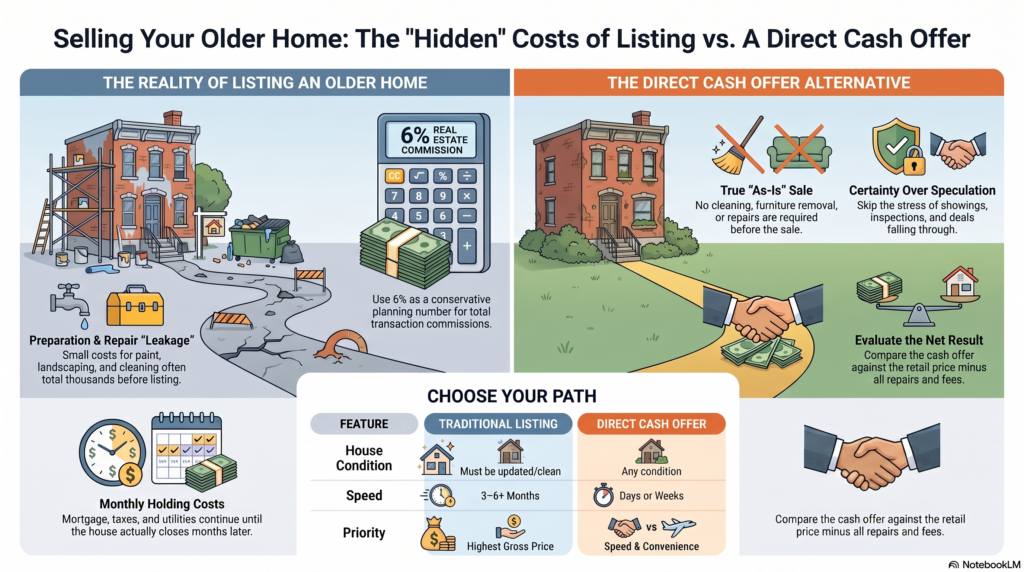
A simple hypothetical Central PA comparison
Consider a hypothetical older home near Harrisburg. It has dated carpet, wallpaper, a damp basement after heavy rain, an aging roof, and years of belongings to remove. The owner believes the house might sell for $275,000 after preparation.
The seller should not assume that $275,000 is the amount to compare with a direct offer. A useful comparison would subtract the likely cleanout and preparation budget, expected brokerage compensation, possible inspection credits, transfer and closing expenses, and the cost of carrying the house until settlement. The seller should also account for the possibility that not every dollar spent on improvements will be recovered.
The direct-sale comparison should be equally honest. It may be lower than the hoped-for retail price, but the offer should be evaluated with the avoided work, shorter timeline, reduced uncertainty, and current-condition purchase terms included in the decision.
Questions Homeowners Often Ask
How much should I budget to sell an older house?
There is no universal percentage because the result depends on the home’s condition, the agreement with the brokerage, buyer concessions, preparation costs, and how long the property takes to close. For early planning, estimate each category separately rather than relying only on a commission percentage.
Do I have to repair everything before listing an older home?
No. A seller may repair and list, list the property as-is, or sell directly in its current condition. The home’s condition can still affect the price, buyer pool, inspection negotiations, financing, and likelihood of closing.
Does selling a house as-is eliminate Pennsylvania disclosure requirements?
No. Selling as-is generally describes the seller’s position on repairs. Pennsylvania sellers still generally must disclose known material defects as required by law.
Are real estate commissions negotiable in Pennsylvania?
Yes. Brokerage compensation is negotiable and is not set by Pennsylvania law. Sellers should ask what each quoted percentage covers and calculate the expected total compensation and fees under the written agreements.
What holding costs should I include while waiting for the house to sell?
Include the mortgage, property taxes, insurance, utilities, lawn care, snow removal, maintenance, and any vacancy-related or second-housing costs that continue until closing.
When might a direct cash sale make more sense than listing?
A direct sale may deserve consideration when the house needs substantial work, the owner does not want to spend money preparing it, the property is creating ongoing expenses, or simplicity and certainty matter more than pursuing the highest possible retail price.
How a direct sale with 717 Home Buyers differs
717 Home Buyers makes cash offers based on the property in its current condition. A seller is not required to clean out the house, update paint or flooring, improve the landscaping, prepare for traditional showings, or complete repairs for 717 before closing.
That does not make a direct sale the right choice for every homeowner. A well-maintained house in strong retail condition may be better suited to a traditional listing. The value of getting a direct offer is that it gives the homeowner a concrete option to compare with the likely net result of listing.
Learn how the 717 Home Buyers process works, see how a cash offer is calculated, or use the home-selling options comparison.
Key takeaways
- An older house can be well built and still require meaningful preparation for retail buyers.
- Not completing a repair does not always eliminate its financial effect.
- Pennsylvania disclosure duties and repair decisions are related but not identical.
- Real estate compensation is negotiable, but sellers should estimate the total transaction cost.
- Holding costs continue during preparation, marketing, negotiation, and closing.
- The best option depends on likely net proceeds, time, cash required upfront, certainty, and homeowner effort.
Watch the Central PA Property Talk episode
Brian and Chris walk through these costs, the Pennsylvania disclosure issue, commission planning, holding costs, emotional strain, and the practical difference between listing and selling directly.
Read the Podcast Transcript to Learn More
Brian: Hi, and welcome back to the Central PA Property Talk Podcast. I’m your host, Brian, and this is our co-host, Chris.
Chris: Hi, everyone. Thanks for joining us today.
Brian: The Central PA Property Talk Podcast is produced by 717 Home Buyers in Lancaster, Pennsylvania. We buy houses for cash throughout Central Pennsylvania, but we also want to educate our community and help homeowners make informed decisions when selling a house.
Chris: And today’s question is: What are the unexpected costs of selling an older house in Central Pennsylvania?
Brian: Right. Because at first, the math can seem pretty simple. You look at what similar homes are selling for, subtract what you owe, and figure that’s roughly what you’ll walk away with.
Chris: But that number can start shrinking pretty quickly.
Brian: It can, especially when the house isn’t already cleaned out, updated, repaired, and ready for professional photos and showings.
Chris: And we’re not trying to scare anybody today.
Brian: Not at all. This is just an honest discussion about the costs homeowners may not think about when they first start running the numbers.
Chris: Because usually it isn’t one huge surprise.
Brian: Right. It’s five or ten smaller things that keep getting added to the list.
Chris: Paint, carpet, landscaping—
Brian: Cleaning, removing furniture, fixing a railing, replacing a few light fixtures. Then somebody looks at the roof. Somebody notices water in the basement. An inspector raises a question about the electrical system.
Chris: And suddenly the house that looked almost ready isn’t quite as ready as you thought.
Brian: That’s the situation we want to help people think through. This is especially relevant with older homes around Central Pennsylvania. We have brick row homes, farmhouses, older detached homes, twins, and houses that have been updated a little at a time over several decades.
Chris: And an older house doesn’t automatically mean a bad house.
Brian: Not at all. Some older homes are extremely well built. But they may still have dated finishes, deferred maintenance, previous renovations, or systems that retail buyers are going to look at closely.
Chris: So where do the costs usually begin?
Brian: Often before the house is even listed. A real estate agent may walk through and recommend painting several rooms, replacing worn flooring, removing wallpaper, trimming trees, improving the landscaping, cleaning out the basement, or getting rid of old furniture.
Chris: None of those sounds enormous by itself.
Brian: That’s the issue. Maybe you spend a few hundred dollars here, fifteen hundred there, then rent a dumpster, hire cleaners, and pay somebody to handle repairs you don’t have time to do yourself.
Chris: And you’re spending that money before you know what a buyer will actually offer.
Brian: Exactly. Now, sometimes that preparation is worth doing. If the house is fundamentally sound, the work is manageable, and the seller has the time and money, preparing it well for the retail market may help produce a stronger result.
Chris: But you need to compare the cost of the work with what it’s realistically going to add to the sale.
Brian: That’s the key. Spending ten thousand dollars doesn’t automatically add ten thousand dollars to your net proceeds. Some improvements help a house sell. Others simply bring it up to the condition buyers already expected.
Chris: What if the homeowner doesn’t want to make the repairs? Couldn’t they just list it as-is?
Brian: They can. But selling as-is doesn’t necessarily make the financial effect of the problems disappear. The cost may show up as a lower price, fewer interested buyers, a repair credit, or renegotiation after the inspection.
Chris: So there’s a difference between not paying for a repair and avoiding the cost of that repair.
Brian: Exactly. Imagine a homeowner near Harrisburg with a house that has dated carpet, old wallpaper, and a roof that may need attention in the next few years. The seller can choose not to replace the roof. But a buyer may still account for it in the offer or ask for a credit after the inspection.
Chris: And the inspection is another point where expenses can appear.
Brian: Right. A seller may accept an offer and feel like the hard part is over. Then the inspection identifies basement moisture, electrical concerns, plumbing leaks, wood damage, or an aging heating system.
Chris: Does the seller have to agree to every repair request?
Brian: No. That depends on the agreement and the negotiations. The seller may repair something, offer a credit, reduce the price, say no, or decide the deal no longer makes sense. But once those issues enter the conversation, they can affect both the money and the certainty of the sale.
Chris: There’s also a Pennsylvania disclosure issue here, right?
Brian: There is, and we don’t want to overstate it. In Pennsylvania, residential sellers generally have to disclose known material defects. That doesn’t mean you have to tear open walls or go looking for problems you don’t know about. But if you know the basement takes on water, the roof leaks, or there’s another material problem, it needs to be handled honestly.
Chris: Disclosure and repair are two different questions.
Brian: They are. Disclosing a known issue doesn’t necessarily mean you have to fix it. The issue might be reflected in the price, negotiated with the buyer, or accepted by someone willing to purchase the property in its present condition.
Chris: And we’ll link to the official Pennsylvania seller-disclosure information in the episode description so people can read the actual requirements.
Brian: Yes. This is general information, not legal advice, but homeowners should understand that selling as-is doesn’t automatically remove every disclosure obligation.
Chris: Another expense people bring up is real estate commission. Didn’t the commission rules change recently?
Brian: The major industry practice changes took effect in August of 2024. Commissions remain negotiable, and there isn’t a Pennsylvania law setting one required percentage. But homeowners should be careful about assuming those changes made the total cost dramatically lower.
Chris: So if someone says, “I’m a great negotiator. I’ll get the commission down to two percent,” what should they ask?
Brian: They should ask what that two percent actually covers. Is that only the listing brokerage’s compensation? Could the buyer request that the seller contribute toward the buyer agent’s compensation? Are there additional brokerage or transaction fees?
Chris: In other words, don’t confuse one part of the compensation with the total cost of the transaction.
Brian: Right. Recent private estimates from Clever and FastExpert still put total Pennsylvania real estate commissions in roughly the mid-to-upper-five-percent range. These are surveys, not an official state rate, and every agreement is negotiable.
Chris: But for somebody doing an early estimate?
Brian: I would probably use about six percent as a conservative planning number until you’ve interviewed agents and received the actual terms in writing. You may negotiate something lower. But based on those surveys, assuming the entire compensation expense will come in below five percent may be too optimistic for initial planning.
Chris: And we’ll link to the sources in the description, including reporting about what has happened since the 2024 changes.
Brian: Correct. The goal isn’t to criticize Realtors. A good agent may provide real value, especially when the house is ready for the retail market. We just want sellers to calculate the full expense rather than relying on one appealing number.
Chris: Then there are the costs that keep running while the house is for sale.
Brian: Those can be easy to overlook. Mortgage payments, property taxes, insurance, electricity, heat, water, lawn care, snow removal, maintenance—and sometimes a second housing payment if you’ve already moved.
Chris: What’s the easiest way to calculate that?
Brian: Add up what the property really costs you each month, then estimate how many months you may continue owning it before closing. Don’t just think about the time the house is listed. Include the preparation period before listing and the time between accepting an offer and closing.
Chris: And if a deal falls apart, that clock keeps running.
Brian: It does. You may go back on the market, continue paying the bills, and possibly have new information from the inspection that affects the next negotiation.
Chris: There’s an emotional cost too.
Brian: Absolutely. Stress isn’t a line item on the closing statement, but it’s still part of the decision. There’s the pressure of keeping the house clean, leaving for showings, waiting for feedback, dealing with contractors, wondering what the inspection will find, and worrying about whether the buyer will actually make it to closing.
Chris: Especially when it’s an inherited house, a vacant property, or a home connected with a difficult season of life.
Brian: Yes. Some homeowners are willing to accept that work and uncertainty because they want to pursue the highest possible retail price. That can be a perfectly reasonable choice.
Chris: And others care more about getting a clear number and moving on.
Brian: Which brings us to the direct-sale option. With 717 Home Buyers, we make a cash offer based on the property in its current condition. The seller isn’t being asked to clean the house, update the paint, replace flooring, improve the landscaping, or make repairs for us.
Chris: No traditional showings either.
Brian: Right. And because we’re looking at the house as it sits, the homeowner can compare that offer against the realistic net result of listing.
Chris: Not just the hoped-for sale price.
Brian: Exactly. A cash offer shouldn’t be compared with the best possible listing price while ignoring everything it may take to reach that price. Compare what you may receive, what you’ll spend, how long it may take, and how much work and uncertainty you’re accepting.
Chris: When is listing probably the better option?
Brian: If the house is already in strong condition, you have time, you’re comfortable with showings and negotiations, and your priority is pursuing the highest possible price, talking with a good local agent may make the most sense.
Chris: And when might a direct sale deserve a closer look?
Brian: When the house needs significant work, you don’t want to invest more money into it, the property is becoming a burden, or speed and certainty matter more than maximizing the headline price.
Chris: So what should a homeowner do before choosing?
Brian: Build a realistic comparison. Estimate the preparation costs, repairs, commissions, possible concessions, and monthly holding costs. Then compare the likely net proceeds and the amount of effort required under each option.
Chris: And if you want to see this laid out a little more clearly, we’ve also got a helpful decision-making guide and infographic on our website. We’ll link that in the episode description.
Brian: If you’re trying to decide whether to repair, list as-is, or sell directly, call us at 717-321-SOLD or visit 717homebuyers.com. We’ll look at the property, explain how we arrived at the offer, and give you another option to compare.
Chris: No pressure. Just helpful information so you can make the decision that fits your house and your situation.
Brian: Exactly. If listing makes more sense, that’s useful to know too. The goal is to understand the real numbers before you commit.
Chris: Thanks for listening to the Central PA Property Talk Podcast.
Brian: Be sure to check out our other podcasts and videos, and subscribe, like, or follow for more helpful information about selling a house in Central Pennsylvania.
Chris: We appreciate you spending some time with us today.
Brian: We hope you have a great day.
Not sure what your older house will really cost to sell?
You do not have to guess. 717 Home Buyers can look at the property in its current condition and give you a cash option to compare with repairing, listing, or waiting.
- No required cleaning, painting, flooring updates, landscaping, or repairs for us
- No traditional showings
- A clear offer you can compare with your likely listing net
- A calm conversation with no pressure to accept
Call 717-321-SOLD or request a cash offer online. You can also compare your selling options before deciding.